 |
| Krzysztof Maziarz |
Hex Turn Actions
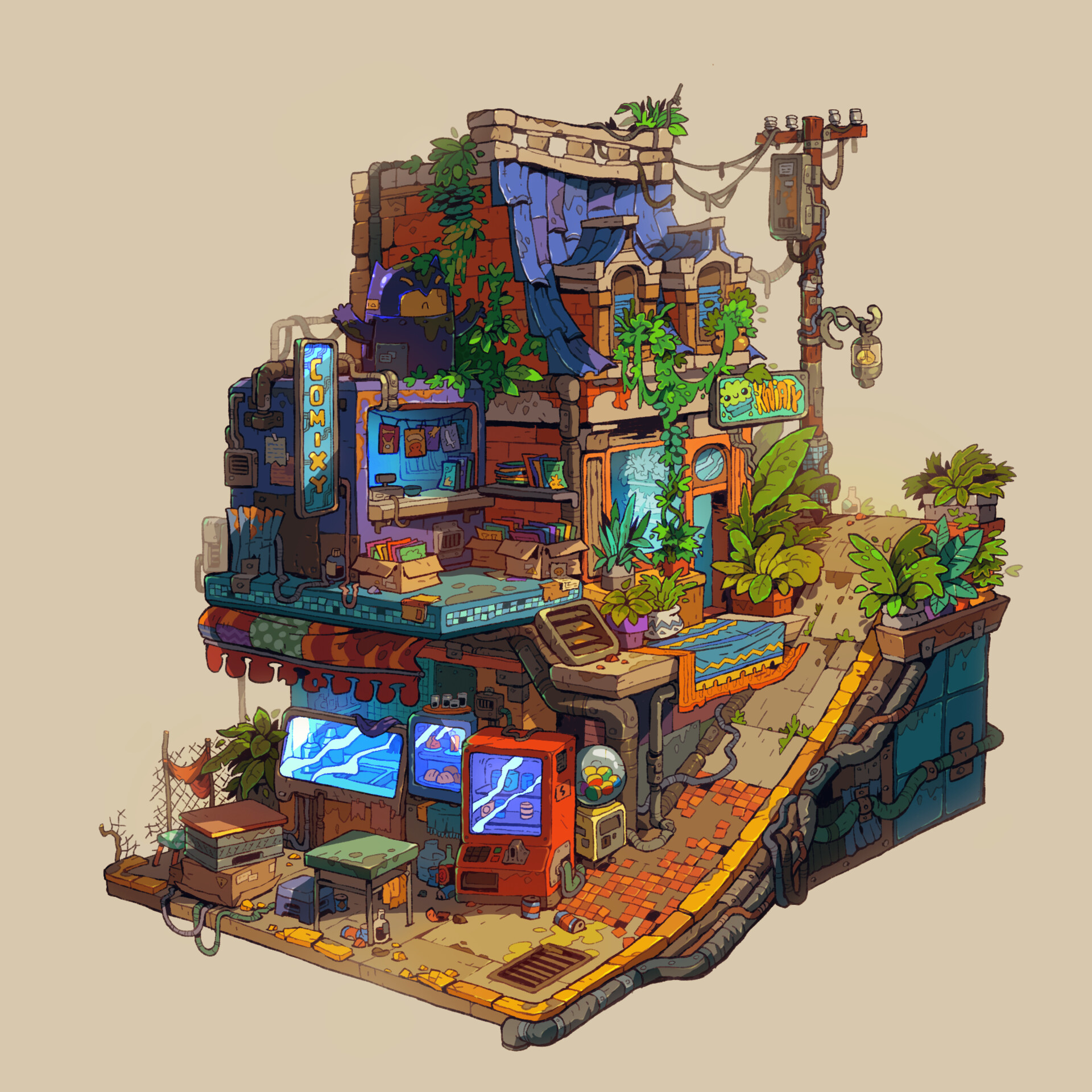
Find Shop
To find a shop, first determine what category of item or service you are looking for. Then, roll under the relevant town stat on a d6. If it succeeds, you find the item or service. If you fail, you don't. Repeat this. If you succeed, it is a specialist shop. If you fail, it is a shelf or hidden inventory in a more general shop, containing perhaps 3 items. If the category is simple necessities (typically food or farming equipment), you find one, but can still roll to see if it is high quality fancy stuff.
If the settlement is of considerable size, one can take a second hex turn to try again. If it is small, the DM may say that there is no more stores in town to check. If it has a Bazaar or Market, roll twice and take the better.
Find Quest
To find a quest, roll both stats. If one or both is over, there is a problem in the associated aspect which could do with solving. When it is solved, somebody of that aspect owes you a favor.
Religious Attendance
By spending a tenth of your recent earnings, you buy some sacrifices/donate to the church/purify yourself with incense. You become Ritually Pure, and gain the favor of local religious-types. As well, roll under Otherworldly and you get a minor blessing (post forthcoming).
Have a Good Meal
By spending twice the cost of a ration, gain 1d6 HP (or temporary HP) and have a nice meal. You only benefit from this once per downtime period, but if there is a different pleasant, restful thing in town, like a hot-springs, patisserie, or lodge, you can gain an identical benefit from that.
Local delicacies:

Town Turn Actions
Get an object repaired
Choose an object you want repaired, re-enchanted, or elsewise fixed. Roll under the corresponding town stat, and you find tools, materials, and possibly expertise to do so. Otherwise, it is only half repaired, and may break again or not work perfectly.
Do Chores
You do enough odd jobs and errands to afford 3 rations, or else obtain three rations worth of favors.
Relax
You decompress after some traumatic adventuring, and clean all the blood and muck off yourself. The combination of your civil attitude and appearance gives you a +2 to reaction rolls with people.
A Night on the Town
You go out drinking responsibly, having a good time at some pub or nightclub. Spend at least 3 rations, but no more than 10 rations. This counts for 1.5 times the XP.
Rumor Gathering
The Old Ladies, Bartenders, and Midwives share you the gossip. Roll under Earthly and you get some blackmail material, roll under Otherworldly and you hear some true sounding spooky happenings. In addition, roll on whatever rumor table you have at this time.
Downtime Actions
Train
Working by yourself or with a teacher, you learn part of one skill. By spending three (possibly non-consecutive) downtime actions training that skill, you can become proficient. You gain a small benefit or feature, as well. For instance, the ability to make a second unarmed attack, the ability to pick a specific kind of lock, or the ability to try an impress someone with snippets of a language.
If one of your stats is below average, you could raise that stat by 1, up to slightly above average.
Research
You put out feelers and gather information, whether ancient lore or castle blueprints. If you roll under the relevant town stat, you find at least one piece of information regarding your subject of study. For instance, you might find a stanza of a poem, a useful diagram, or a map with a few rooms filled in. It is definitely true. Otherwise, treat this as several rolls on the rumor table.
Magical Experiments
Select one spell of yours, or one rune or scroll you've found. Describe as well the way you will be experimenting. Depending on the way you experiment, an intelligence (or other mental stat) check, a roll under the town stat, or a sacrifice of materials or coin may be required. You learn a version of that spell which is appropriate to your caster level and is changed slightly to reflect your conclusions. If you fail, save vs. magic or take (caster level)d10 damage.
Set up a Base
You use favors, money, and elbow grease to set up a little place where the party can meet, sleep, and do a bit of preparation. Roll over Earthly and its free, because it was abandoned or you made it yourself. Roll twice more: if the first is under Earthly, it has the amenities you are used to (such that you no longer need to roll for tools for Repairing Objects); if the second is under Otherworldly, it has magical resources enough to do Magical Experiments.
 |
| 朱玮玮/Zhu Weiwei |
[These are abstractions for when you don't want to play out the whole thing, or for when you are unsure of something. If you can run everything by yourself with full detail, and you want to, then you should!]