Showing posts with label Hypogeum. Show all posts

Friday, October 6, 2023

GLoGtober 2.1: Castles in the Air (Hypogeum)


Its GLoGtober once again, and though I pretty much missed last year, I thought I'd return to form with some Hypogeum-posting. The prompt this time is "Atlantis-type situation but in reverse. It goes up instead of down."

Angels (also called Harpies, or simply the Winged People) are a race generally considered legendary in the Hypogeum. It is said they have wings rather than arms, and live in floating cities obscured by the haze of the upper reaches. Which is rather preposterous, isn't it? If humans developed wings, they could never use them to fly. They're too heavy! And floating cities? How would they navigate the narrow archways and passages that connect caverns?

Nevertheless, they are real.

(Spoilers ahead)

Angels are a race of sorcerers. Magic doesn't run in their blood, however. It runs in their feathers. Angel feathers are uniquely adapted to collect and store ambient magic. However, they use this great power rarely. This is because, without it, they would fall out of the sky.

Magic, as everyone knows, is a pervasive gas which tends to collect in liquids or crystals, suspended like the carbonation in a soda. Contrary to this force of suspension, magic is much lighter than air. This is why angels can fly, and why powerful sorcerers are such whimsical assholes: they take themselves lightly.

Because their wings collect magic, frequent flight actually makes it easier to fly, rather than tiring them out. However, an excess of magic in their wings can be rather uncomfortable in daily life (rather like being constantly tugged by your lapels). Since water can easily take up magic, it is easy to wash off, and produces quite potent magic potions. When they are flying, the water condensation on their wings often drops to the ground as droplets, often incorrectly called Angel Tears. When they are at rest, they save these magic potions for a different purpose.

The cities of the angels are diverse. However, contrary to popular belief, they are seldom monolithic structures. But they tend to have this in common: like the angels, they float by magic. Most angelic cities are aggregate structures, with each building or household being held aloft by its own means, and tied to other buildings by ropes. The means by which they hold magic vary: some employ balloons, while others are built around highly thaumiferous plants or minerals. The maintenance of these means is the main use of angel tears among angels themselves.

Rarely, lone angels or solitary clans will build their homes on large aerial darkbeasts. Though this often prevents them from joining a larger angelic city, it is generally agreed to be sick as hell.

The aggregate and modular nature of most angelic cities explains the conundrum of travel. When they wish to enter another great chamber in the hypogeum, they simply lead their buildings through whatever passages are necessary in single file. As well, it is entirely possible for certain buildings to break off and gradually reassemble a city-of-theseus elsewhere.

The extreme concentration of magic in their society obviously makes them targets for ambitious sorcerers and agents of the dragon. This is the reason for their extreme isolationism and nomadic lifestyle.

Wednesday, August 2, 2023

Hypogeum Classes, Revised

I was looking over my Hypogeum Classes recently and, wow, they are bad. There's a whole class for heists. Heists! Completely irrelevant to the game. So I'm making them better.

Percichen on Tumblr, I think

Sword-Artist

Sword-Artists are those who kindle and unleash their Life, transmuting it into Magic. Unlike sorcerers, they don't need to supplement their Magic with potions. However, their chaotic and fiery Magic is pretty much completely useless for spells. Instead, they just punch people clean in half. Sword-Artists are commonly found among Humans and Darklings. Greyfolk are less common, and Folk are rare to say the least. Skeletons cannot become Sword Artists.

Each template of Sword-Artist gives +1 To-Hit

A: Sword Art, Soul of Flame
B: LIKE LIGHTNING
C: War Aspect
D: Life-Drinker

Sword Art
By focusing for one round, you may unleash an attack that always hits and deals an extra d4 damage for each sword artist template you have. If this doesn’t kill them, you’ve misaligned your meridians and can’t use this until you rest.

Soul of Flame
When you attack with a Sword Art, white flames kindle around you. You do not control these fires, but they do not hurt you. Your next turn, if there is anything flammable nearby (besides your own clothes), your fires will start normal fires.

LIKE LIGHTNING
You can choose to sunder your weapon when you use your sword art. When you do, the d4’s become the weapon’s die. For the rest of the fight, your pure killing intent functions as that weapon (though melee if it was ranged).

War Aspect
When you fight with your pure killing intent, it instead functions as any weapon you have held before. Fights don’t end until everyone you can reach in one turn is dead. You must keep fighting until the fight ends.

Life-Drinker
When you kill a being that did not die instantly to your sword art, your meridians are re-aligned, and you count as having an extra sword artist template.

Satoshi Matsuura

Strife's Child

A Strife's Child is an Adventurer, a Dancer, and a Coward. They can feel the rhythm of Battle, and move in time. Anyone can become a Strife's Child.

Each template of Strife's Child gives +1 AC

A: Motif, Abscond
B: Clever Thing
C: Battle Tech
D: Finisher

Motif
While in Combat, you may focus for a round to begin a kind of war-dance, or battle-trance, which increases the tension of all creatures in combat. When you begin a Motif, place a d6 on the table showing a one. This is the Motif Value. Increase it by one each round. All creatures get a bonus to To-Hit and Damage equal to the Motif Value. If a creature attacks with advantage, double this bonus.

You may end this effect at any time on your turn.

(Motifs stack with multiple Strife's Children)

Abscond
You may always flee combat.

Clever Thing
You have a feel for the mechanisms found in the Hypogeum, their connections and their ebb-and-flow. If you have seen a lock or key, you know its match by sight. If you find a mechanism, like a lever, by examining the floors and walls around it closely, you can tell roughly the direction its corresponding mechanism would be in (e.g. if it opens a door, you could tell what direction the door is in). You have advantage on strength checks to push large blocks, stuck doors, rusty levers, precarious statuary, etc.

Battle Tech
You may increase your To-Hit, Damage, or AC by the Motif Value (in addition to the normal Motif bonus). You must decrease another of these values by the same (e.g. if the Motif Value is 3, you could increase your To-Hit by 3 and decrease your Damage by 3)

Finisher
You may end your Motif with an attack or spell, which gains advantage. Your DM may allow you to customize your finisher with elemental damage or a special effect.

Lily Seika Jones, I think

Charm-seeker

Charm-seekers seek after charms, obviously. Charms are natural or artificial objects which store Magic and Spells. A Charm will absorb ambient magic from the atmosphere to recharge its spell. A Charm-seeker will naturally have an affinity for a certain type of charm based on their own inherent magic.

While Charm-seekers can be found in every race, each race has a different approach. Charm-seekers are most common among Darklings, who tend toward scholarly obsession. Folk Charm-seekers are very cautious and wary, while Humans tend to be experimental and flippant with charms. Skeleton and Greyfolk Charm-seekers tend to be very ostentatious.

(Digression: Charms are items that contain a spell and at least 1 MD. Anyone can use them, but if the MD are used up it normally takes like a week for it to recharge. Also, if a scroll has its MD used up it just crumbles. A used up charm can't be used to cast as a Charm-seeker)

A: Relic
B: Affinity
C: Ritual, +1 MD
D: Aspect

Relic
You possess a charm which resonates with your heart, called your Relic. It gives you two spells and +1 MD which recharges over 24 hours (in addition to the MD contained within that takes a week). Your Relic determines the type of Charms you seek (e.g. a Fire Wand means you seek Fire or Wand charms). You can cast spells contained in charms with the MD your Relic gives you (not the one it contains).

If you lose your Relic or you find a Charm which better resonates with your heart, you can spend a week attuning to it. The new charm must be one that could have been used by your old Relic (e.g. you couldn't start with a fire wand then change to a water orb, at least without changing to a fire orb first).

Affinity
You've grown in your connection with your Relic, and you come to understand some of the Forces of this world through it. You can identify when something is aligned with the same Force as your relic. When you encounter a creature aligned with that force, you can reroll the lower die of the reaction roll.

Ritual
You can destroy a charm for even greater power. When you do this, you may add another MD (in addition to any you spent on the spell and the MD contained withing the charm) to the spell the charm contained. You may also attempt to create a different effect related to the Charm's spell.

(You can't do the first effect with a scroll, but you can do the second)

Aspect
You can perform a Ritual (see above) with all your MD that can manifest the unique synthesis of your inner magic and the Forces of the World. You are clothed in a raiment of power and can summon a unique and legendary weapon for [sum] rounds.

Charm-Seeker Mishaps
1. MD only return on 1-2 for 24 hours
2. Take 1d6 damage
3. Random mutation for 1d6 turns, then save. Permanent on Fail.
4. Obsession. For 1d6 hours, you pick up and refuse to let go of anything related to your Relic
5. You accidentally drained your charm. Add 1 to your [dice] total.
6. You accidentally broke your charm. Luckily, it's reparable. You can still try to cast with it, but it might break.

Varguy

Sorcerer

A Sorcerer is anyone who consumes distilled magic, though most people only use it to refer to someone who uses it regularly. While everyone has an inner magic, most people don't have enough to make use of their spells. Drinking distilled magic gives the Sorcerer the power to cast the spells of their inner being. It also gives them uncanny visions and otherworldly insight which can lead to madness.

As they use magic, it begins to take root in their being, and their minds become more and more attuned to capturing magic from the atmosphere.

Drinking distilled magic can be done by anyone, giving them the first template of Sorcerer. It also deals 1d6 damage to charisma or wisdom. It lasts 24 hours, or until you lose your MD, and all sorcerer templates are lost when it wears off. Gaining or losing sorcerer templates does not mean gaining or losing levels. A first level sorcerer who runs out of Magic loses his sorcerer templates, but is still first level.

Each sorcerer template gives +1 Maximum MD

A: Spells, Distill Magic, Odd Insight
B: The Twelve Branched Wand
C: Palimpsest
D: Wizard

Spells
You know two spells. One is Sorcerous Blast. The other is determined randomly or chosen by you or your DM. You know how to make a Charm so that you can cast these. You also know how to make an impromptu Charm called a Shamble. This takes a minute and some trash. It lasts an hour, or one use, and can't be used by others.

Distill Magic
You know how to get magic out of things. With a way to boil liquids and condense gases, you can produce a dose of Distilled Magic. This takes a magical ingredient, 3 rations, or a large amount of weeds and herbs. You can also distill magic and spells out of charms in a much riskier process.

Odd Insight
When you read a book, examine a mural, or question someone, you can take 1d4 charisma or wisdom damage to ask an additional question about it. This represents the arcane workings of your mind making a deductive/mystic leap, rather than literally reading another fact or asking another question.

The Twelve Branched Wand
You learn two more spells, and Distilled Magic doesn't wear off until you lose all your MD.

Palimpsest
You regain 1 MD per Long Rest, and can edit your spells by rolling your MD. You can make 1 change for each 6. Negotiate with the DM.

Wizardry
You can make an impromptu, one-use edit to a spell if [highest] is 6.

Sorcerer Mishaps
1. MD only return on a 1-2 for 24 hours
2. Take 1d6 Damage
3. Random mutation for 1d6 turns, then save. Permanent on Fail.
4. Blind 1d6 rounds
5. You smell like magic. Magic eating creatures will be drawn towards you until you bathe
6. All your magic comes out of you in an arcane sneeze, everyone saves vs. being dazzled


For Sorcerers and Charm-Seekers, when you first roll a doom, select Obsession, Rejection, or Transformation. You follow that doom track for each subsequent doom.

Obsession
1. You become obsessed with your source of power. You must immediately seclude yourself for 1d6 days to pursue your power (contemplating your relic's force or brewing way too much magic). If you do not, you take 1d6 permanent Wis or Cha damage.
2. Every day you don't pursue your power, you take 1d6 permanent Wis or Cha damage
3. You abandon all other goals and seek to become the WISEST WIZARD. Make a new PC.

Rejection
1. Your magic leaves you for 1d6 days.
2. Your magic leaves you for 1d6 days, and you cast your most harmful spell targeting yourself with max MD (does not trigger mishaps or dooms).
3. All the magic leaves your body permanently. Save or Die.

Transformation
1. Gain a beneficial mutation. Gain +1 MD.
2. Gain a malignant mutation. Gain +1 MD.
3. Become a Monster. Make a new PC.

They say Doom can be avoided by slaying the Dragon


Friday, October 22, 2021

Hypogeum: the Charm update

We're overhauling Relic-seekers and Sorcerers. Both now use Charms (or, if you prefer, Orbs, Talismans, Amulets, Trinkets, Baubles, Wands, Staffs, Books, Sacrificial Daggers, Urns, etc.). Charms can take any form, though every form must be constrained to these rules:
  • Charms are stored in an Inventory
  • Charms may be lost, stolen, or broken
  • Charms require both special crafting knowledge and intrinsic spell knowledge
  • Charms are art

When starting as a class, Relicseekers Charmseekers choose what kinds of charm they use, or their preferred magic type. For example, "Jewelery" or "Orbs" or "Runes" or "Fire Charms" or "Sleep Charms" or "Once owned by a Pope". Lore and Speech means you recognize charms of your kind, and can speak with adjacent creatures (e.g. Jewelry and Fire would both let you talk to dragons. Runes might let you talk to dwarves. This is really case-by-case.). Prophecy is mostly the same. So is Power Against Power. Aspect lets you manifest the ideal of your charm.
Sorcerers no longer cast directly, but receive spells which they can make into charms. They still need to consume mana potions to use the spells. Also, distill mana will no longer be a spell, rather an ability. Sorcerer's can make "shamble" charms with only pretty trash in only a minute, but these can't be used by others, can only be used once, and last an hour before becoming completely inert. Proper charms need skill, materials, and time.
Characters who aren't charmseekers can use a charm at 1 MD once, after which it becomes inert for a time (normally about a week) 


I just think they're neat
Update: Random_Interrupt has produced a table of charms (as they pondered in the comments below). They are neat, and may be useful to you!

Wednesday, October 20, 2021

A description of the Heavens (hypogeum)


A sketch of an inhabitant drawn by the Sorcerer

This is an account of an expedition to the ceiling, by this humble creature. We made the usual journey from the village of the blue folk (which stands adjacent the cavernous ruins of the orb) by way of the western fountain path to the wall of the cathedral. Here, we set up a camp. We chose this place for it was known to be traversable vertically, owing to the rooms inset in the wall and the ledges higher up. Other places, the wall-rooms of which did not connect well, were not suitable.

After resting for a time (the lights passing half over the water), we resolved to ascend. The first room contained stairs upwards and downwards, as we had heard (it is said that the stairs down were where the Farmer discovered one of his specialty mushrooms, the one which produces a sweet distinctive taste, which was called by the humans "grape"). Traveling upwards, the way for four rooms was only of interest to a rock darkling, and there were a few other rooms besides which were dead ends. In this section I also discovered a fetching hat. 

As we ascended, the rooms became less tame. They were damp with cloud-dew, and colonized by buoyant moss and the creatures that ate it, and the creatures that ate them. Some of these proved troublesome, such as a darkbeast of the wall-crawling variety (There were few more substantial darkbeasts up here. Infrequent were the flat- or pad-footed beasts, and only sparse the hooved ones). The sorcerer called it a "spidery bastard" and set it aflame (we were lucky it was so damp). Many other things happened which I won't write about.

We eventually were forced out onto the ledges. They were paths wide enough that two could comfortably stand beside one another and have generous room. However, they were dangerous, because of the prevalence of flying beasts and other hazards. These attacks were especially dangerous because of the chance of falling. But we prevailed, in the end, and ascended 4 more levels. When this was done, the roof was in sight. However, in the end there was no way to reach it.

When this became apparent, we began looking for other things to do, since we were in such a special position. The sorcerer (who was a human), and the fighter (a grimalkin) simultaneously spotted a rare sight: an Angel flying about clouds. The rest of us could not see it, and the two who did soon reported it vanished. The two both began speaking very excitedly (one should always plug ones ears when this happens, but I did not). The next thing I knew, we were awkwardly flying towards the last place the angel was seen. I later found out that the sorcerer had drunken three mana potions (our entire supply) to give us this power.

I will not bother with the details of this flight, as I cannot properly render them. But soon we found where the angel had disappeared from and where it disappeared to. Simply, there was a village in the sky held aloft by some kind of balloons. 

Some people who read this might not have seen a balloon or even heard of it. It is a practice done by wizards where they take a special sack and fill it with magic which is lighter than air. This makes the sack float, and it can be tethered with a string and produce mirth. Sometimes a balloon may be made large enough to carry a person into the air for a short time. Humans claim that it is also a practice in their world, and more common than most other magics.

The balloons which held this village were greater, of course, than the balloons anywhere else seen. And this was not the only wonder, for it was evident that there was some illusion disguising the village causing it to be invisible from the ground. And of course there were the people who lived there.

It is a common rumor that there is a sort of human which possesses wings rather than arms and may fly around. It turns out this is true. The humans call these "Angels" (which is what I called it above) or "Harpies". The Sorcerer (who was beyond excited) called them "Ritos". The Sorcerer often says weird things.

They indeed flew around on wings which were their arms. Their legs and feet were dexterous as arms and hands, though the fact that they needed to either sit or balance on one foot made them disinclined to do unnecessary things. They occupy themselves with hunting and maintaining their village.

They hunt for things like aerial beasts, buoyant moss and fungi, as well as ground dwelling creatures small enough to take back to the village. They steal cloth to sew their balloons. They perform the magic that fills them. They gather water that condenses on them to drink. These are their daily tasks.

They are hidden, and free from the influence of the Dragon. They do not revere the forces, for they are humans and do not enter the ruins at all. They live perpetually in anxiety of the failure of their village, for if it does, they will have to hide away in high rooms. Now that we have found them, they will move on so that they are not found. Because of the fantastic nature of their habit and the incredulity of those who live below, they do not object to our speaking about them.

We stayed there for some days, until we left by the same manner as we arrived.

(Translator's note: This text was found in an abandoned village, presumably the "village of the blue folk", hidden in a secret compartment. I have taken many liberties in this translation to make it interesting to human readers, but the main events and descriptions, as well as a few phrases of particular interest, are intact. The veracity of these events is suspect, but I've learned not to dismiss anything)

Sunday, October 17, 2021

Ruins


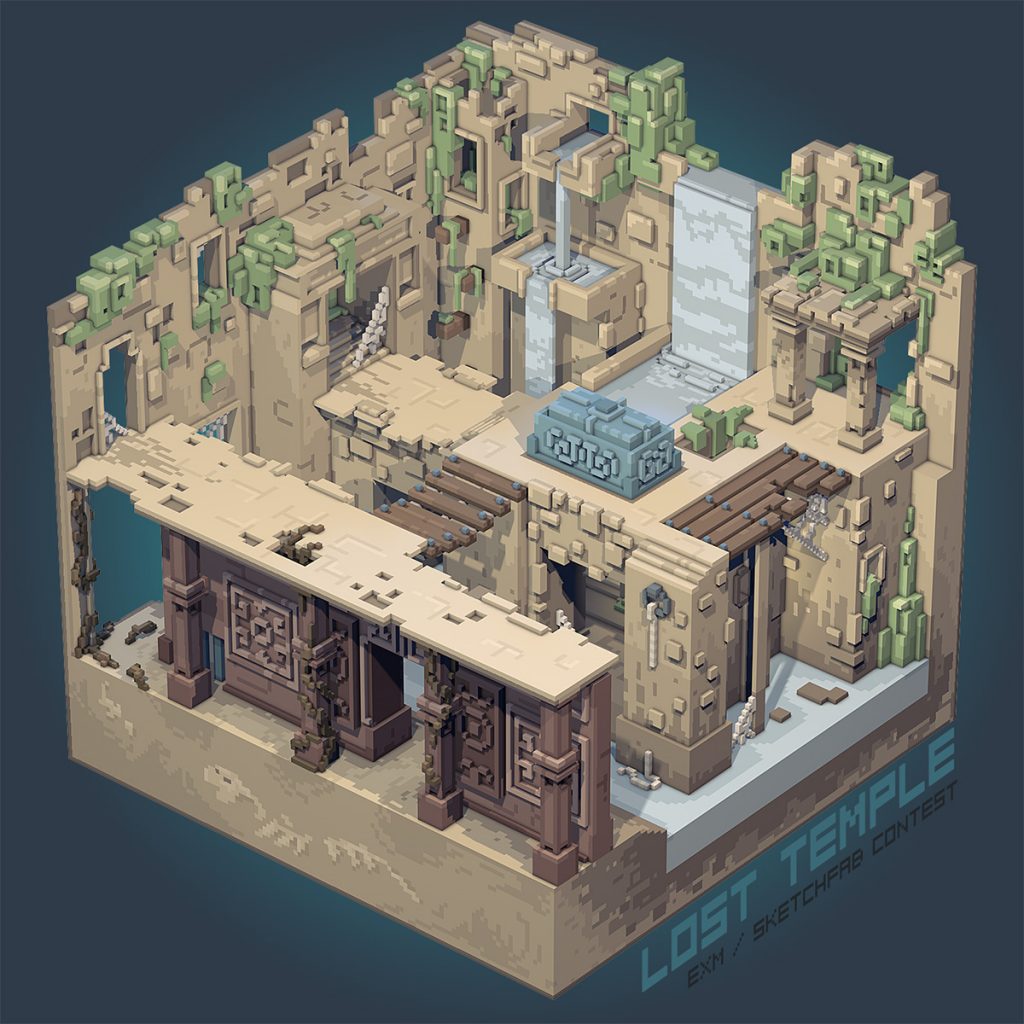
Ruins are spaces considered holy by Folk. Inside them you find things that you would find in the rest of the Hypogeum, only denser. This makes them very hard to traverse. Ruin Complexes are normally circular, or some equivalent, becoming denser and denser as you get towards the center. As such, most people give them wide berth, though being able to go nearer the center would make a nice shortcut. Most ruin complexes are almost a mile wide, and dominate the cavern they are in.

They dominate in more than one way. The presence of ruins in a cavern seems to affect, or at least be a good indicator of, the force that Folk revere. Or maybe the Folk built the ruins in honor of a force they already revered? The Folk are weird about religion, as we all know. That all to say, each Ruin Complex seems devoted to, or at least themed around, one Force. Oftentimes they are also pervaded by that force.

As previously stated, ruins are dense. They are full of puzzles, treasure, and most of all, Lore. Loads of (untranslated) hieroglyphs, murals, and gut understanding. Most of the puzzles and treasure are also lore. The ruins will tell you what a Force is like, what is sacred to it, what it hates, etc. There are also depictions and statues of various creatures, most of which are unidentified, but one of which is the Dragon (see: Dragons, forthcoming). Finally, there will be the Prophecy, that a sacred hero will come out of the ruin and defeat the Dragon.

Some say that the hero already came, and he died. Others say he joined the Dragon. Still others say the Dragon used to be a hero himself. These sorts of confusions come about when you're only going off somewhat abstract pictures.

There are also more mundane secrets besides, like the location of treasures, hidden wells, gates, etc.

Piranesi

The ruins are haunted by living statues. These can be found rarely in other parts of the world, but, like I said, the ruins are Denser. They also have unliving statues, and the living ones could hardly be called statues. But they move, and they're made of stone, and the name stuck. Like most things made of stone, very difficult to kill. Have a sword artist or sorcerer at the ready, dangerous as they are, those statues are more so.

Don't get caught up in a puzzle, or you'll die.

Voxelmade

Now I said they are holy to the Folk, and its clear that they have some association with Folk religion, but I feel I should expound more upon this. It is a topic of intense debate (as intense as Folk can get) about whether Folk, or anyone, should be allowed in the Ruins at all. One might expect some hassle if one emerges from a ruin in sight of those people who frown upon it, and especially if one is carrying sacred treasures. 

Folk priests make use of the ruins to understand their faith, navigating them through preordained paths and solutions to review specific commands or insights. The knowledge and tradition of these paths is what makes them priests and not just devotees (devotees might be just as holy and authoritative, but lack the knowledge and experience of ages). If a priest is feeling candid, he might show the way to those he trusts, or might simply tell them the information they seek.

Just the same as the debate regarding entrance to the ruins, is the debate regarding the sort of creature the hero will be. Some Folk cannot imagine the hero coming from among their own race, while others cannot imagine them coming from another race.

Darklings for the most part don't take part in these debates. As usual, they are rather secretive regarding their beliefs. Arites seem pretty hopeful about it though.


Thursday, October 14, 2021

Hypogeum Tables vol. 1

Folk Self portrait (Folkling)
These are tables that DM's can use to randomly generate things in the hypogeum. If you are hoping to play, don't read these! Well, maybe do. I can't stop you.

Part 1: Villages and Folk

Topology

  1. Open and defensible Gerum1. This is the most common, if you don't want to roll
  2. Crevice or Ruin-gap
  3. Amphitheater
  4. Collection of Ruin-Stupa in an open or elevated Gerum
  5. Clustered around a spire, tower, or pillar
  6. Hanging from the ceiling, accessible by ceiling connection
  7. One big ruin building
  8. A vague sphere of under-rooms
  9. Clinging to the wall (also the side rooms)
  10. Inset into a hill or ziggurat, probably with spirally stairs.

 Physical Quirk

  1. Mossy and overgrown
  2. Giant mushrooms
  3. Tombs
  4. Houses shaped like their residents
  5. Well built and cozy
  6. Engraved
  7. Exotic Stone
  8. Crystals
  9. Water Features
  10. Supernaturally Dark

Social Quirk

  1. Diverse 
  2. Even more uniform than usual
  3. Devout
  4. Mercantile
  5. Play a lot of War
  6. Host their own adventuring party
  7. Scattered Pre-modern or even modern tech
  8. Scholarly
  9. Colonized
  10. Sorcery and or Relicseeking common

Cult

  1. The Dark
  2. The Flame
  3. The Moss
  4. The Mechanism
  5. The Flood
  6. The Orb
  7. The Stone
  8. The Cube
  9. The Gate
  10. The Song
  11. Personality Cult
  12. Fairies

Exports

  1. Pottery, Cooking
  2. Pottery, Decoration and Storage
  3. Stonework
  4. Metal Tools
  5. Food, Staple
  6. Food, Luxury
  7. Textiles, Beastsilk
  8. Textiles, Weavemoss
  9. Medicines
  10. Fuel

Food Source

  1. Moss
  2. Fruit Bush
  3. Mushroom, Sour
  4. Mushroom, Sweet
  5. Mushroom, Savory
  6. Herded Beasts
  7. Hunted Beasts
  8. Tubers

Folk Appearance

General:

  1. Amphibious
  2. Repitilian
  3. Humanoid
  4. Vague

 Eyes:

  1. Small beads
  2. large, wet puppydog eyes
  3. Appropriate to their type
  4. Inappropriate to their type
  5. Eye stalks
  6. Eye spots

Head:

  1. Lumpy
  2. Snout
  3. Round
  4. Crest, Neck-Frill, some other weird thing

Ears:

  1. Tympanum
  2. Large, Round
  3. Large, pointy
  4. Oh those are actually gills

Color:

  1. Red
  2. Red-Orange
  3. Yellow
  4. Brown-green
  5. Bright green
  6. Forest green
  7. Aqua
  8. Blue

Clothes:

  1. None
  2. Loincloth
  3. Chlamys or cloak
  4. Sari or Toga
  5. Primitive Pants
  6. Robe
  7. Necklace
  8. Plants


1 a gerum is a room-like enclosure, with high walls but often without a ceiling, inside a maze or complex of other such enclosures. Like a cubical, but big and not necessarily quadrangular or perfectly aligned.

Tuesday, October 12, 2021

Gates (Hypogeum)

[Portals don't get an art]

Gates are sort of a black box. They are found, occasionally, in the Hypogeum. They look like glowy bits of vaguely circular 2d geometry about the size of a person. They can appear when you solve a puzzle or get to the end of a dungeon. Most of the time they, at least one of the gates appear nearby the thing that "caused" them. Sometimes they don't, though. People near the gate when it opens sometimes report hearing a sound, but accounts vary (sometimes like the tinkle of a bell, sometimes a "VOOM", different people hear the same gate opening different ways). They don't appear to be made out of Stuff, and they aren't affected by magic. If you break a wall around a gate, the gate stays there.

Almost all gates are blue. 

Gates, as was implied, usually come in pairs of two. Going in one gate brings you out the other. Simple. Gates are permanent. No one has ever reported a gate closing, at least. Gates always go both ways. This is not always useful. You can't be halfway in a gate. Going into it at all brings you out the other. Nobody knows what constitutes matter gates transport. It almost always includes people and creatures (including living plants), but sometimes doesn't include things like clothes, while other times you can push a wheelbarrow through. Smart travellers wear weavemoss underwear.

Gates usually transport you a fair distance. People report gates that they open usually bring them to somewhere the want or need to be. Definitely not always true, but it is significant. Other "favorites" of gates seem to be local landmarks and places so far away nobody's ever heard of them, except maybe in legend. If gates were truly random, as some claim, it should almost always transport you very far away, since there is a lot more of "far away" than "close". So they probably aren't exactly random. Also, gates that transport you far away apparently tend to be "temporary one-ways". That is, they'll drop you non-lethally from a high up platform that is difficult to ascend to, or release you in a lake so deep you barely make it to the top, or exit into a structure that locks as soon as you walk out.

You shouldn't go into a gate if the geometry isn't perfectly two dimensional, and you shouldn't go through a gate that isn't blue. Or at least, so they say.

[I don't like this prompt]

Saturday, October 9, 2021

Darklings (Hypogeum)


A Darkling I encountered, who distinguished himself with a stately Tricorn. Unsettling, but amiable.
Darklings are inhabitants of the Hypogeum. They are, as I have previously said, seemingly related to Folk, and many possess carapace-like skin, or else are vaguely insectoid. They are generally more serious, dour, and skillful than the folk, though there are, of course, myriad exceptions. They possess a cultural inclination towards concealing clothing. This, and their already exterior, lends them the general appearance of two eyes on a spindly-limbed silhouette. But this is all common knowledge.

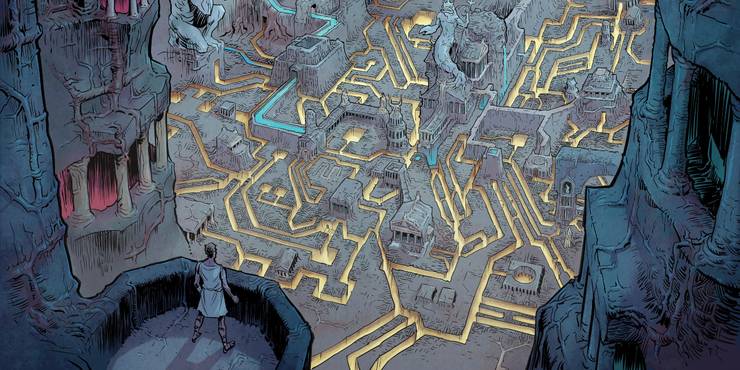
Where Folk are at their height of civilization with a town, Darklings have Cities. It is unknown whether the Darklings built their cities, or whether they were part of the Hypogeum from the start, but they are certainly fantastic. Most theories say that it was an original part of the Hypogeum, since the materials used to make them don't seem to have been mined or scavenged from the maze around them. They are gothic structures, very pointy and solemn. They are expansive, with many skyways and underground (well, "sky" and "ground") passages. Many Darklings never go outside in their lives.

Darklings are able to sustain themselves mostly without farming by, ironically, hunting and pastoralism. Darklings only inhabit sections (called "Stasarae", "Dwells", or "Abiders") of the city at a time, cycling through the whole city slowly while the rest are overrun by shadowbeasts and other creatures, which they hunt. As well, they herd herbivorous creatures through the Stasara to eat the moss that accumulated there since it was last inhabited. This almost exclusively carnivorous diet, as well as the skill needed to hunt shadowbeasts, has given them a fearsome reputation. Some folk even believe that Darklings became all dark and carapaced because they relied so much on darkbeasts for food.

While some darklings herd and hunt, many are more scholarly. Scholars study the notes left by previous generations on the walls of the the Stasara. They are in the process of continual archaeology: they come to a Stasara, study the murals and artifacts, write their findings as well as new developments down in the form of murals and artifacts, and move on. Darklings are secretive to one another, and very cryptic, so by the time that the tribe returns to the same place, the information written there was likely lost, and becomes new information. Every piece of writing on every wall becomes a fragmentary history of the entire civilization told by hundreds of authors.

Darklings similarly are as opaque as possible about their romance, though I do believe they have one. To them, seemingly, all romance is equally taboo, but all of them break that taboo as quietly as possible. Knowledge of both parents is rare. Depending on the community, either the mother raises them in conjunction with all the men (and others) of the community, a child is taken in by a mentor figure (who might or might not be their parents), a single communal parent or parental group raises all children, or the community as a whole raises them. The most brazen Darkling might leave a note as their tribe migrates to the next Stasara, and the child might find it when they are older or if they range far.

Like Folk, they work for the most part on a barter system, with every treasure approximately worth the same as every other treasure, and food mostly shared. However, Darklings are much more likely to have specific and obvious preferences. A certain Darkling might collect swords, while another collects hats, while still another collects artifacts of human culture, or skeleton bones! Though, perhaps he only wants to inter them. Even Darklings who are not relicseekers collect, though obviously relicseekers are more common among them. They won't trade the things they collect things away, but they'd give you a treasure for things that might otherwise be trash, or several treasures for one otherwise valuable.

This tendency for collection, and as well, for creation (for darklings like to make fine things), means that their tombs often contain goods important to them in life. While most treasures will be redistributed to the community, the most important treasure to a certain darkling will often be left with them in a Stasara. They believe that it takes until the tribe cycles back to the Stasara for all the life and magic in the body to dissipate, and to reclaim it before hand is disrespectful and dangerous.

If it wasn't apparent, Darklings do not bury their dead. They allow scavengers, mold, and moss to overtake it, leaving the body in the stasara but otherwise in the open. When they return to the stasara, they might clean up the remains (bone and carapace), putting it in a neat pile, if it is already fully clean. If moss lingers on it, they allow the creatures they herd to eat the moss and any remaining flesh, before cleaning it up the same. Or they might throw out the bones, or use them for divination, or use the carapace as further armor (which does not help their reputations). 

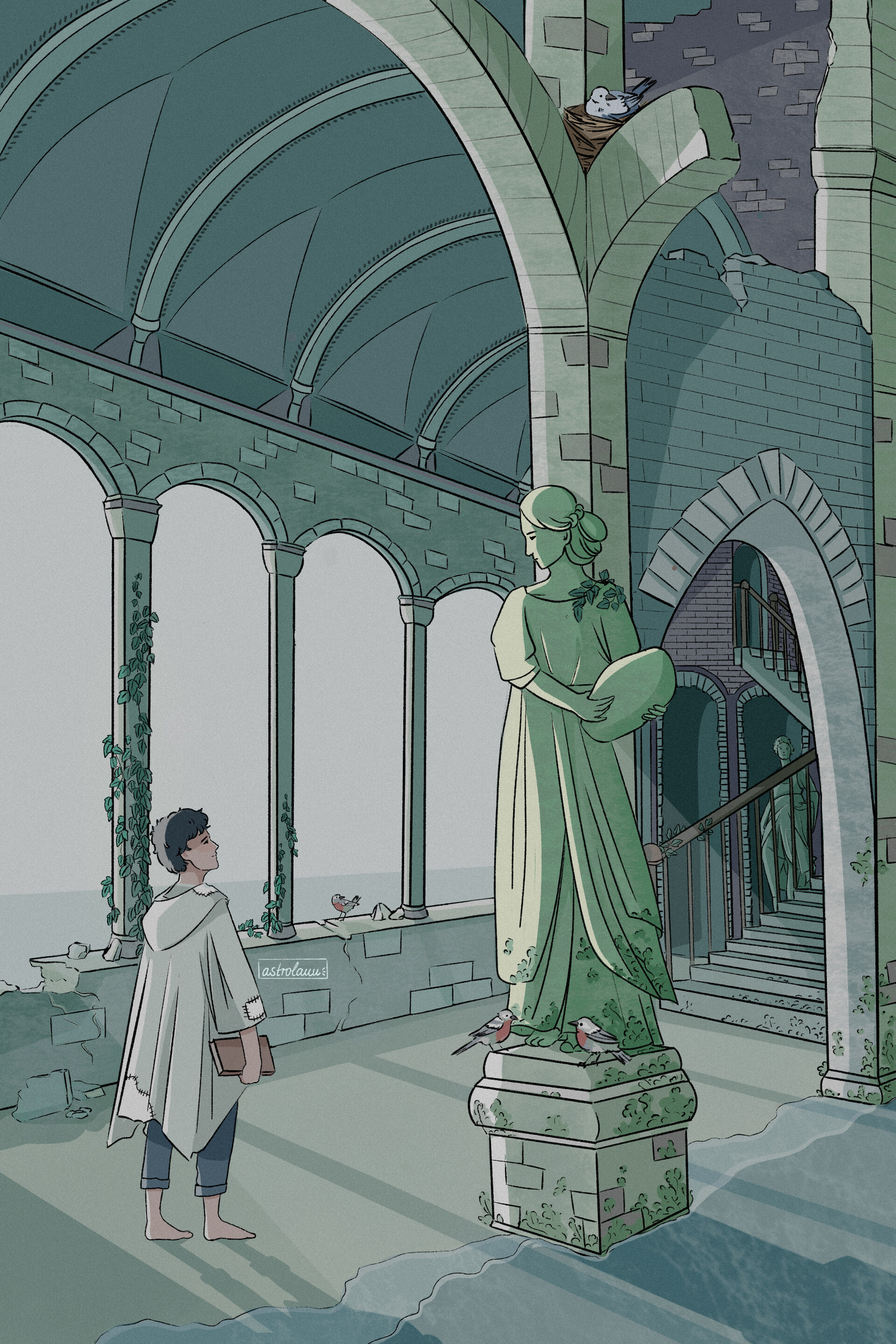
As stated elsewhere, the religions of Darklings are apparently more complex than their Folk counterparts. While they revere much the same natural forces, they more often personify them, or worship their servants and great ancestors. For instance, a cult of the Moss I encountered venerated the Great Teacher, whose words brought forth lush spores on an otherwise barren city, as well as his disciple, the First Shepherd. They do not, as a whole, believe in an afterlife, but they might believe that their force might be honored or placated by reminding it of the good relations they have had with it. They tend to pick a statue present in a certain Stasara and

The majority of Darklings are at least henotheistic. They are more aware than their Folk counterparts of the existence of others devoted to other Forces, whether or not those Forces are real or worthy. Notable groups are those that venerate all the forces, called the Arites, and those who reject them all, the Tergites (both pronounced with the e on the end). The Arites are known for their decoration of the cities in which they live, with many-colored prayer flags and many statues festooned with decorations and offerings. The Tergites are known for their iconoclasm and for their music and games, which, divorced from their religious context, have developed in ways both good and bad.

(The statues found in the Hypogeum only sometimes depict certain races. Just as often, they are abstract. Some cults favor statues of certain races. Its not known why.)


Thursday, October 7, 2021

GLoGtober 6: Playing War (hypogeum)

[image pending]

As previously stated, Folk play a game called War. Well, game is a light term for it, but it certainly isn't actual war. They treat it a bit like it is, though. Each Folk village has a sort of platform or rostrum near its center. Sometimes it is used for orating (ambitious humans be warned, get in the Folk's graces before trying to get up on there, or you will be heavily accosted). But when Folk formally declare War, it is used as a Goal area. The goal of the game is to get some items, called gazae, from the opponents rostrum to yours, while protecting your own items. Opponents will negotiate the gazae to be warred over, but most often it is some treasures. The game will either last a predetermined amount of time, or until a certain number of the opponent's gazae have been scored. The gazae can be scored back by retrieving them from your opponent's rostrum. Human readers will notice some similarities between this and Capture the Flag.

There aren't any rules regarding capturing opponents, aside from "do whatever you can to incapacitate them" and "try not to kill them". Part of the terms of negotiations is whether players can use their treasures, whether the gazae or items outside the game. Most of the time, players can use gazae but not items outside the game, because to use the gazae they must be taken into the opponent's territory, and opponents might then use those gazae themselves. 

Sometimes the gazae is more symbolically important, such as the force of their shrine or symbolic items, like a beloved statue. Sometimes the gazae are mere tokens. Sometimes those tokens signify important things, like rights to use a piece of land, or vassalage. Villages get to keep the gazae they capture, and these are either kept communally or given to the participants who did the most to get them.

The practice of War is very important. Refusing a war outright is a shame on a village, while cheating at War shows other villages that they are not to be trusted. War shows off the accomplishments of a village, while providing the opportunity for less powerful villages to get needed assets. It also, obviously, provides a way to settle conflict, as well as test defenses and strategy. Any race can participate in War, often in specialized roles.

Also its pretty fun.

Wednesday, October 6, 2021

GLoGtober 5: Cultist (Hypogeum)


A Folk cultist approaches the Flame with trepidation

The faiths of folk are predictably simplistic, and perhaps monotheistic, revering a force of nature above others, often enshrining a representation of such attended by a priest or cult. The Flame, the Moss, the Dark, and the Maze are all common faiths. Each village is dominated by one, and Folk of different faiths tend to pretend other faiths don't exist. A devotee of the Dark and a devotee of the Flame, if they were to talk and broach the subject, seem almost not to notice that the other is talking about a completely different force. Even discussions of aspects of the force get parsed into their native faith. Its really kinda weird.

Darklings have a more complex faith, seemingly based on the same thing. They actually recognize other faiths and have theologies encompassing them. Again, they generally view one force as supreme, and other forces as either subservient or malign. While this is generally true, Darklings of some places revere all these forces, while Darklings of other places shun all of them. As well, Darklings are more prone to personification and a more personal religion, as well as more structure.

The signifiers of a devotee are usually distinctive. Often a garish hat or patterned "robes"; sometimes facepaint or a mask. You can tell when a cult is about when you see lots of folk with the same thing on, which is different from those around them. Folk devotees don't seem to have much fervor, beyond reciting some catchphrases (for fun?). Darklings are more secretive and devout. A folk cult is basically just a fun club. A Darkling cult is a serious investment in philosophy.

Link to Class

GLoGtober 4: Exploring the Hypogeum


The Hypogeum is a world which consists of an underground complex (though whether there is any ground for it to be under is a matter of some debate). It can be thought of as a series of linked, immense, cathedral-like caverns, honeycombed with room-like divisions, and rooms below and in the walls of this "central" structure. Sort of like a hedge maze with basements in a roofed courtyard of an circular apartment building. If you make it to the wall, there's probably a door which can take you about three rooms deep in the wall, maybe more or less, maybe connecting to another "courtyard". These courtyards are miles across, and contain both many structures and lots of empty space.

Exploring the "overworld" traditionally (room by room) is both tedious and unnecessary. Traps are rare, and most of it is just empty space, as said before, and it is very possible (though somewhat risky) to just go above obstacles by climbing the walls (aerial predators exist and going above the walls makes you more visible to monsters in the rooms around you). Generally, its dangerous monotony dividing settlements, ruins, and other important structures, with encounters and weather. Which means it can be modeled as a wilderness!

The above is the working hexflower for the Hypogeum. I am dissatisfied with it currently, but what can you do?

Key:
👾 - Monster, or monsters
⚙️ - Puzzle, blocking a site containing (roll as though exploring)
👑 - Treasure
🏛️ - Dungeon
🛖🛖🛖 - Village, a settlement in an open-ish area, often Folk
🛖 - Solitary NPC, a master of some kind or an eccentric
🌿 - Overgrown area
⛲ - Fountain or a safe area
💧 - Flooded area 
📜 - Ruins, uninhabited non-dungeon site
⛩️ - Gate
🌁 - City, or settlement among megastructure, often Darklings

Normal (non-weighted) hexflower rules. You can backtrack to places you've been before, and you can't always explore further in a certain location. 

[Might add examples, or change things around here, but I'm a bit behind right now.]


Sunday, October 3, 2021

GLoGtober 3: Orbs and Everything Else (Hypogeum)


Orbs

As I wrote about in my Previous Post, it is believed there are three prime substances in Hypogeum: Stuff, Life, and Magic. I wrote there mostly about the movements and behaviors of Life, but here I will talk mostly about the behavior of magic. Like Life, Magic can be either found in a pure, gaseous state, or dissolved into another material. As well, Magic has a material memory like Life. This memory takes the form of Spells.

Orbs are a shape of stuff which is good at absorbing Magic. The type of stuff the orb is made of might have some affect on this ability. Certainly, the type of stuff it is made of affects the spells it is predisposed to. Orbs made of a once living material, like bone or wood, cast spells related to the magic present in the being it was procured from. Orbs might have this sort of intrinsic property if made from another magic containing material.

Other orbs are made from materials which don't normally contain magic, or which have had their magic fully drained or purged of its memory. Crystal is most favored for this (see below). Into such a blank orb is placed a seed spell, which can thenceforth shape the magic absorbed into it. This process of shaping can affect the appearance and form of the orb naturally, or very learned people can try to modify an orb to be more suited to a spell or class of spells. This makes the variety of orbs we find in the world.

Orbs, like swords, might not be made of specific type of stuff, but instead be made out of Orb. These can be found commonly, and might be blank, but more often have a spell in them.

Crystals

Crystals are both a shape and a type of stuff. They are ordered and regular. A cubic crystal forms cubes naturally. A pointy crystal forms points, given more stuff to work with. Despite this natural tendency toward one shape, most crystals can be formed into orbs manually, with some skill and persistence.

Crystals are valuable for one property of theirs: It takes considerable effort to get magic in and out of them. This may not seem like a good thing, but it means crystals are often naturally magical blanks, and if you can get pure magic in them, they store it without turning it into spells. It isn't that difficult to do, its just harder than natural processes allow most of the time. If you find a magic crystal out in the wild, that means either someone put it there, or something really magic happened there once upon a time.

Crystals are used in jewelry and art objects for three reasons: firstly, and obviously, its pretty; secondly, it makes good magic item batteries, making the objects useful; and thirdly, for safety. Magic infused crystals glow, and crystals inset into magical objects become infused. If you are handed a fancy thing, you can tell its not magic (thereby, not cursed) if it has crystals that aren't glowy. Still makes it hard to tell if you are being cursed by a magic item, but at least you know that some random jewelry isn't going to curse you.

You could, of course, just use crystals as light sources. Many people do, especially in areas with lots of them. Adventurers who are sorcerers or relic-seekers use them very often.

Runes

Runes are another shape of Stuff. They are very bad at storing magic in general. However, each rune is alright at storing one specific spell. Magic with any other spell memorized, or no spell memorized, simply slides off it. Magic with a memory is very rare in natural, ambient conditions, so just carving a rune and leaving it out won't attract the specific spell it is attuned to. The spell must be transferred to the rune. 

Most runes are carved into other materials. These runes are durable, but can't hold almost any magic. Some runes are written on other materials with ink. These are both less durable and have less capacity than carved runes. Some inks are very good at storing magic, and so have higher capacity than carved runes. 

The best practice, many say, is to scribe with this magic-storing ink on very magical paper or vellum, making a scroll. Scrolls can basically hold a whole spell, both energetically and mnemonically, but casting the spell drains the stuff of magic, which has the same effect as removing all the water in a sand castle. 

Some scrolls exist in the Hypogeum, but they are very rare, and runes aren't used very much in the current era. The most research about them is done in darkling settlements. Scrolls in general are very basic looking, showing a single large rune. Runes also form naturally, as described above, on some spell containing items, like orbs.

Books

Just like scrolls, books aren't common in the Hypogeum. Most Folk aren't much for literacy, but if they are, they paint things on hard tablets or walls, or carve it in clay, or do other things besides. Its simply too damp to make books feasible. However, they do exist.

Books are sometimes brought in by Humans and other otherworlders. These are written in glyphs that only humans can read, and are generally worthless in the hands of others, unless they are collectors. However, some books written by humans are dangerous things known as "poetry", a kind of tool used by humans to enhance their already silver tongues. Poetry read by humans can be intoxicating, and can rival magic in terms of its ability to affect Folk. Some writings in ruins or dungeons have been identified as poetry by human explorers, lending further credence to the theory that humans were the original inhabitants of the Hypogeum. These ruin poems are known for their ability to make any meaning to them impenetrable to all but the most clever and free-thinking Folk (PC Folk).

Books can also be found, rarely, as treasures. Like all treasures, these seem apparently native to the Hypogeum. Often they have a large rune on the front. If the book is a relic, the rune is an indicator of the spell contained within. Some wise Darklings have discovered that treasure books have internally consistent language, unique to each book so far as they have found. This has become widely known, though not widely used except by weirdos.

A note on Treasures and Relics: Treasures are valuable things found in the Hypogeum. Among almost all people, it is generally accepted that one treasure is worth mostly the same as another, barring extraordinary circumstances, and not accounting for taste or individual usefulness. If you bring a fancy hat back from your adventures, its valued the same as a magic item or filigreed staff or, indeed, a book. Mostly they are used for sentimental and aesthetic reasons anyways. Relics are items, sometimes treasures, that can be used by Relicseekers and contain an intrinsic spell. The nature of magic in an relic is such that only Relicseekers of a certain predilection can use them. An Orb couldn't be used by a Bookseeker, after all!

Porbal

Portals

[Post Pending]

Wizards (Damn Them)

The magic present in people is diffuse and faint, normally unusable, just the background level of magic in any place. Wizards are people who cultivate magic in themselves. Most of the time, wizards are sorcerers, also called arcanophages. They drink or eat things with lots of magic in them so that they may concentrate that magic. Most often they drink magic infused water, sometimes (incorrectly) called distilled magic. Not everyone does, though. Relicseekers attune their minds to a certain sort of relic, allowing them to use or siphon the magic inside objects.

The heavy use of magic has effects on the body and mind of its users. Both sorcerers and relicseekers gradually are changed and mutated by the presence of magic, in such a way that allows more magic to enter their bodies, and be more easily manipulated. Orb-like organs, maze-like brains, and other mutations allow true wizards to contain many spells discretely, absorb magic naturally, and modify existing spells.

However, learning new spells is difficult. Either new relics or runes must be obtained, or maddening insights must be undertaken. The easier way is to take apprentices. Each person has some faint magic already inside them, and that magic has a memory, and that memory is a spell. Cultivating that magic to the point that a person's natural spell may be cast, and thus learned by the teacher, leaves the apprentice an almost capable wizard. 

Of course, for as many true wizards are out there, there are a thousand middling sorcerers and superstitious relic-seekers, skirting along on not even a basic understanding of the nature and behavior of magic. Such is life.

Saturday, October 2, 2021

GLoGtober 2: Slimes (Hypogeum)


In the Hypogeum, the wise Folk say, everything is made of three things: Stuff, Life, and Magic. Stuff is solid, life is liquid, and magic is normally a gas. Stuff makes up things like rocks, people, etc. Life and magic can be absorbed in certain kinds of stuff, like a sponge. They disagree on whether these elements can be created, or whether they simply change into one another. 

Most creatures have both life and magic in a framework of stuff. Cooking something normally drains the life out of it, making it drier. This is good, because too much life in a steak might mean it starts kicking around your stomach, making you sick. Stuff without any life in is much harder to digest though, sometimes even impossible. Life tends to stick to one shape, regenerating the kind of stuff its in. That's why your blood stops your wounds, while other people's blood makes you sick (unless you are a vampire). 

But if cooking evaporates the life, then you can put a condenser over the top and distill it. Distilled life doesn't have this "memory", and is normally called a health potion. But there is an easier way.

A slime is the simplest form of creature. Its basically just a blob of life keeping its shape. There's almost no stuff in it. It rolls over other organics and digests it, its own life-memory overcoming theirs. Most of the time, it leaves behind all the other stuff that can't be digested. In this way, it is pretty dangerous.

However, life memorizes stuff. It has a much harder time memorizing life. That is to say, slimes are easy to pop, and only a light simmer makes high quality health potions.

Some slimes are more advanced, and have incorporated other materials into their bodies. These slimes are valuable, because the materials they contain are very easy to extract. However, they are also more dangerous, as their life-memory is much stronger, and thus, they are both harder to kill and quicker at digesting. Magic slimes are the easiest and most common variant.

It should be noted that life memorizes the first life-filled thing it comes across. Drinking life that already has a memory, even a weak one, has side effects. Stay safe out there.

Life comes in Green, Red, Black, and White flavors. Magic, Blue, Purple, and Yellow.

Saturday, September 18, 2021

ANSWERING PHLOX'S 51

GLoGhack: Hypogeum

1. How do I make enough money to have regular meals? (Deus)

Folk will probably feed you if you help them, but currency is not really a thing.

2. What do people do to get Fucked up around here?  (Vayra)

Its hard to find a substance in Hypogeum that isn't psychoactive. The local wisefolk could probably direct you. Sorcerers are arguably constantly fucked up on mana potions.

3. How much racism are we talking? Fantasy racism or regular? (Vayra)

A little racism, as a treat. Humans think Folk are stupid babies, and Darklings are demons. Folk think humans are cool weirdos and maybe thieves, and Darklings are honorable warriors and sorcerers who I'd never like to meet, no sir. Darklings think Folk are hedonists, and humans are possibly creatures of ancient myth. Everyone thinks skeletons are very mysterious, and grimalkin are just humans but friendlier and sneakier.

4. Who's the nearest religious figure I can annoy? (Vayra)

The folk have temples of various sorts, and wisefolk (sometimes relic-seekers) run them. In general, ridiculously easy to co-opt.

5. Why do most sensible people avoid [Magic Users]? (Gorinich)

In order of magic-ness: Sorcerers undergo violent mood swings, relic-seekers are servants of some power, Sword-artists are master murderers as a matter of course, Fools are clowns, Clever-Things are thieves, and Strife's-Children generally lack empathy and fear.

6. What's the local sports team? What do they play? are they any good? (Vayra)

Folk play War. Its basically capture the flag with clubs. Do they know what actual war is? Its still pretty dangerous, because the main field is the parts of the dungeon between two settlements. The teams are simply named after colors, but humans tend to give them more fanciful exonyms, which the folk accept. Your team are the blue mushrooms, and are kinda trash.

7. What's my sword made of? I started with three rations, what are they? Are they any good? (Vayra)

Swords that come from the Otherworld might be made out of steel, but swords around here are made out of sword, or whatever material you gave the folksmith. Your rations are probably mushrooms, moss, or shadowmeat. Its pretty good. Sweet.

8. What actually is a GLoG? (Everythings)

GLoG is a kind of Taoist Alchemy

9. Where can I find some orbs? (Gorinich)

It is hard to find places without orbs

10. What do orbs do? (Gorinich)

Orbs are the most common type of relic, and are easy ways to get spells, though you'll have to do some research to get the spells out of them.

11. Why's the Milk gone? (Everythings)

No cows. If someone gives you milk, don't drink it.

12. Can I have a pet? Can I have a weird pet? Can it talk? (Vayra)

You can only have a weird pet, cause animals don't tend to get isekai'd with you. Humans sometimes keep Folk as "pets".

13. Am I allowed to be famous from the start or do I have to figure it out in play? (Vayra)

You can be famous in the starting village. This doesn't mean that much.

14. Am I allowed to be cursed from the start or do I have to figure it out in play? (Vayra)

Depends on the curse.

15. What possible explanations would you accept for me being a time traveler, or from a different dimension? (vayra)

Possible explanations: you are human. That's it.

16. Is evil real? What is it? (random_interrupt)

Maybe? Some seekers collect and study "evil", but we're not really sure if that means anything besides aesthetics.

17. Frogs? (Everythings)

Yes but also no.

18. What's the best combat aircraft available? How much does it cost? How much does a flight of four of them cost? (vayra)

Angels supposedly exist. Is that a combat aircraft? Does casting flight make you a combat aircraft? It can make you a ICBM, I guess.

19. That's too expensive. How can I steal one/four? (vayra)

Shut up

20. Are italians real? why not? Can I say my rations are ragu, in case I run into some? (vayra 🙄)

Italians are real. You can start with ragu.

21. Is there some kind of wizard boss, or kung fu boss, how good is his kung fu/wozerdry? (random_interrupt)

There's probably one of each among the darklings, and maybe one among the skeletons?

22. What's the die I'm going to be rolling for checks? Is my character aware of its existence? What's the save vs. existential horror? (fifth)

d20. aware of the dice? If you are a sorcerer you might be. No save, just choose whether you want to comprehend or ignore. 

23. How many children am I allowed to start with? How about chickens? (vayra)

Humans don't start with any, or at least any present. Folk can start with some. Chickens aren't present. 

24. What's the deal with demons in this setting? Pure evil, just a type of creature, incarnations of desire or sin, depends on the subtype? (sylvanas_iii)

some Humans call Darklings demons. more often, they call Fairies  or shadowbeasts demons, and are there more correct. They are just a creature, though.

25. Same as the above, but with angels (sylvanas_iii)

Angels are supposed to exist, and they are just. Humans that developed wings. Sometimes they call the spoiler above angels.

A darkling sorcerer

26. How mad do people get when you pick their pockets? Are we talking "fight to the death" or "nooooo stooooop" or somewhere in between? (vayra)

Darklings fight to the death, Folk are "nooooo stooooop". Grimalkin will take it as a challenge to steal back from you. Skeletons nobody knows, but speculation is that they'll just wait until you die and hope they can pick it up later, unless its very urgent.

27. How long is a round? How is momentum tracked? [Can I make a peasant railgun] (fifth, abridged)

Six seconds, probably. If you could get enough momentum, it'd probably count as a sword-artist's sunder, or if the person is the one with momentum, the strife-child's motif. No, an object can only be passed twice per round.

28. Do I have to be from around here? can I be from space? (random_interrupt)

As previously said, humans are from vaguely the modern world. Maybe you were an astronaut? Ditching the spacesuit would be wise, I think.

29. Roll under or roll over? What are the ability scores and what's an average score? (sylvanas_iii)

Roll over. Standard six. 3d6 or 4d4. or 4d6 and you don't start with a class.

30. What happens if I steal another player's character sheet? can I mind control them, or do I become them? (fifth)

 You get to control them, yes, for the purposes of being ridiculous or not having to wait for their player.

31. How easy is it to learn to cast FIREBALL? (sylvanas_iii)

Sorcerers start with sorcerous blast, which can be fire. They might also be able to distill the spell Set Alight. Relic-seekers could find both, depending on what their relic theme is.

32. What happens at 0 hp? is it different for NPCs? What about below zero? (Vayra)

At 0 hp you get knocked out. Same for npcs, but not the same for shadowbeasts. When you generate your HP, you also generate your -HP the same way. -HP is kept divided by the dice you rolled (i.e. if you roll 3 and 5, it is divided like 3+5, or 5+3). When a negative hit die is depleted, you suffer a wound. If all are depleted, you die. Some NPCs have 1 HP and only -HP.

33. How much xp do I get for buying pizza? (fifth)

am I the one to determine that?

34. Does destiny exist? Can it be changed? Can I stand outside it and watch you all like a spectator at a puppet show? (random_interrupt)

People generally agree that it does. People generally agree it can't. If you manage to watch it, you're probably still a puppet.

35. what direction do numbers go in? (fifth)  

West

36. Have you playtested any of this? (Vayra)

Do I look like someone who's finished a draft to be tested?

37. How many types of magic user are there? do they stack? (sylvanas_iii)

A quote: "Magic is just the academic application of metaphysical power which fighters also wield more bluntly to, for example, be able to take 20 times as much damage as a normal healthy adult". That is to say, they're all magic users. Yes they stack. 

38. Are there sumptuary laws? like, will I get flogged for wearing magenta? (random_interrupt)

Some Folk do that. Most don't.

39. What are the important dates to know? Big festivals, metaphysical anniversaries, eclipses, comets, etc? (vayra)

Without the sun, moon, or stars, or really any repeating temporal variation, there is no such thing. Sometimes two or three folk will decide its party time, and then that's what happens. 

40. Can I play as many goblins? a Mimic? a literal dragon? (sylvanas_iii)

Maybe, Maybe, Maybe

41. What exactly is a hitpoint anyway? Toughness, luck, skill, or chi? (random_interrupt)

Its chi. Attacking someone with any hitpoints just bounces off their AT field or whatever. Which is why some things only have -HP and some attacks bypass HP

42. What kind of goblins are there in this world? if there aren't any, what's the closest thing? (sylvanas_iii)

Folk are vaguely goblins, but also vaguely kobolds and vaguely bullywugs etc.

43. If I play a priest, do I have any actual political power, or will I get treated like any other dusty knave?  (random_interrupt)

Depends on so many factors the question cannot be answered tidily. 

44. Can I use this class I found on the internet with the same name and concept as one you've provided? (phlox)

No, probably not. I've tried to make things rather flavorful and self-contained. You can suggest revisions to the classes though, I'm very open to those

45. What's the optimal substance to consume before playing this GLoGhack? (and why is it orbs?) (everythings)

Sourpatch kids or other fruity, sour candy.

46. How many classes are on offer? How many of them are magic things? (sylvanas_iii)

Sword-Artist

Strife's Child

Clever Thing

Fool

Relic Seeker

Sorcerer

As I said, they are all magic.

47. Can I play (insert literally any character here)? (sylvanas_iii)

Maybe. Try to change the name though.

48. How much do I have to read? (phlox)

You never have to do anything

49. Will we actually be using the inventory rules, or can I just pretend? (phlox)

Its all pretend

50. Why? (purplecthulu)

Desperate Escapism

51. Whom? (fifth)

Thee

some froggish Folk exploring