Showing posts with label death. Show all posts

Thursday, July 30, 2026

Learn What I Heard the Sea-born Seer Relate (GLAUGUST, M&M: Fates)

The lot has been cast, and my quest decided: the PRIMEUMATON spake that I must "Breathe New Life into an Old Post". So I shall, and This post seems apt for my Mazes and Minotaurs game.

Fate

The Fates sit before their hearth at the center of the world (which is everywhere), spinning, weaving, cutting, mending, all the twistings of the lives of men. They do this at the behest and consent of Zeus, king of the gods. Of course, he commands them only because he is fated to. Who can search out the workings of the gods?

All the gods (including rather minor ones) can reveal fated futures to men, and especially to their priests and special oracles (which can sometimes include horrible beasts like harpies or sphinxes). It is a bit of an effort. Way easier to just tell them things that were or are, rather than will be. Further, there is a difference between a thing prophesied and a thing fated. Prophesies can be conditional: You will surely die unless you eat that berry. Fates are absolute: You will kill your father and marry your mother.

The conditional nature of prophesy is not uncertainty in the future: the Fates know your future, inexorably. It's instead the choice of the god giving the prophecy to not give you the full story. They're still truthful, and probably more useful than a fate. But if you choose to eat the berry and not die, that was your Fate from the beginning. If you don't eat it and die, that was your Fate from the beginning too. But the god isn't telling you which one will happen.

When a character levels up, they roll to detemine if their Fate has been decided. Roll 1d10, minus the magnitude of their luck modifier, whether positive or negative. If this result is equal to or under their new level, their Fate is decided. A table of fates is given below, which can be rolled by the DM, modified by the character's Luck mod. Or the DM can simply choose which one they have. The gods have been known to play dice, but they aren't bound by them.

Example: Alexandros and Boops (it means "ox-eyed") level up to level 2, and have a luck mod (after ability enhancements) of +1 and -1 respectively. They both roll 3 on their d10 roll. The magnitude of both their luck scores is 1, so they both subtract 1 from 3 and get 2, which is equal to their level. Then, the DM rolls for their Fates. Alexandros gets a +1 to his result here, whereas Boops gets a -1 to his.

Fates (2d6)
≤2. You are going to (or have already) wronged the gods, and will die an ignominious death and have one of those special ironic punishments in hades.
3. You shall die by the sword. Which probably isn't news to you.
4. You shall die by your child.
5. You shall die in some circumstance (1d6):

1. Fire
2. Water
3. Under the earth
4. In the sky
5. On the horns of a bull
6. Due to Bees.

6. Roll again. If you roll this result again, treat it as 5. The result of the second roll is reworded to leave a multitude of interpretations.
7. Roll again. If you roll this result again, treat it as 8. The result of the second roll is complicated by the following factor (1d6):

1. You shall come within a hair's breadth of this fate, but it will not happen.
2. This fate will only come after you have wandered nearly the whole world
3. This fate will only come after you have lost what is dearest to you
4. This fate will only come if you devote yourself to one specific god.
5. This fate cannot come to pass until a certain person or monster is dead
6. This fate is surely impossible, and can be safely ignored! (until it comes down on your head)

8. You shall defeat the terrible [Monster/Evil wizard/What-have-you].
9. You shall learn a great secret.
10. You shall wage a war against [City-state] and win.
11. You shall found a great city.
12. You shall ascend to godhood.
(results 2-5 are "Fated Deaths" while results 8-12 are "Fated Quests")

While you possess a Fate, you cannot die until it is completed. You could be chopped into pieces, turned to stone, cast into the pits of Tartarus, wither until you become a grasshopper, etc. but you can't die. Mechanically, this means that while you could be incapacitated by damage, and "die", effects such as a Nymph's Kiss of Life or a Mithraic Priest's Divine Resurrection have no time limit to work on you, since you aren't technically dead (just mostly dead, and therefore slightly alive). You can also be raised by divine intervention, or even minor intervention (Thanatos will recognize there's been some sort of a mix-up, and bring you back).

However, if you would die, instead you lose something else. This starts at the edges of your life and works in. Maybe you lose your father first, then the rest of your family, then your good name, then that magic item you use all the time, then perhaps a level, then your sight or strength... This also happens if you ignore your fated quest for a year, or do something drastic to avoid a fated death (such as trying to kill your kid). At any time you may declare that you have "nothing left to lose". This stops the "clock" for your tragedies, but you'll roll twice and take the lower result for all rolls that don't work to fulfill your Fate, and you die as soon as possible after you fulfill your fate.

Just because you have a Fate doesn't mean the spindle of Clotho stops turning. You still roll to see if you have a new Fate each time you level up. However, while you have an unfulfilled Fate, your luck modifier doesn't affect the d10 roll (though it still affects the fate-table roll), and you roll an extra dice for each unfulfilled fate you have and take the highest result. Also, rolling a Fate from a level up doesn't tell you (the player or the character) what the fate is. You still need to find an oracle for that, and probably should do it quick before some oracular monster uses it to mess with your head.

Example: Boops levels up to level 3 while still having his fate unfulfilled. He rolls 2d10 to see if he has a new fate, and gets 3 and 8. His luck mod doesn't affect this at all, and he has to take the higher. 8 is higher than his new level, so he doesn't have any new fate.

Finally, none of the gods take kindly to being toyed with. If you use your outlandish Fated Death to do some dumb shenanigans, expect the sudden appearance of your paradoxically unborn child, or a mysterious swarm of angry bees.

Tuesday, August 28, 2018

The Fates of Men

What path has been set for your souls? Roll below:

  1. Destined to die. Roll on the deaths table
  2. Destined to do. Roll on the quest table
  3. Undestined. Fateless. Any high, any low, anything may befall you. Tread carefully.

Death shall come for you:
  1. By the Sword
  2. From the Sky
  3. In the Cold
  4. On the Water
  5. By your Child
  6. On a Flame
Disadvantage on death saving throws made when under the rolled circumstances. Cannot die otherwise. The disadvantage only counts if you are actively avoiding your rolled circumstances. A pirate with a waterborne death won't incur any disadvantage. If you have done something drastic to avoid this death (e.g. tried kill your kid), when the circumstances arrive, it's instant death.
Let it be known that this child shall:
  1. build a great kingdom/marry a beautiful prince(ss)/gain fame and glory in the land of ____
  2. find secrets lost to time/learn an undeniable truth/have great wisdom and understanding
  3. wage war and win/fight the enemy of his time/bring honor to his family 
  4. bring peace that shall last until the end of time
  5. achieve greatness if they sacrifice/honor/do ____. roll a d4 on this table to see what greatness they will achieve.
  6. Fail when most needed. Roll a d4 on this table to see what they shall fail to do.
This character cannot die before their fate is completed. They automatically succeed at rolls that advance their fate, though this is at the DM's discretion. If their fate is ignored for a year, a great personal tragedy befalls them. If no tragedy can befall them, they take disadvantage on all rolls that clearly don't advance their fate, And they die as soon as possible after their fate is completed. Also, if 6 is rolled, treat it as if they had rolled 1-4 except at the end they fail. This means you have to Try to fulfill a destiny you know you will fail on. Sucks for you, but if you do well you might live.

Application

Players get to choose if they have a destiny, or it can be rolled randomly with a d4 (treat results of 4 as a 3). Beyond the choice of if they have a destiny, they have no control over what their destiny is. Think of it as a choice of going to the oracle or not. The DM may roll for their destiny, or may choose it at their discretion. Also, the DM may make it as specific or vague as they want. 

I would recommend 0-2 fated characters if you have 3 or more people in you party. At three people, 1-2. At 2 people, both of them probably should be fated. A 1 person party should definitely be fated. The reason for this is that beyond three fates, it gets hard to juggle all the quests, and with a smaller number of people, fates keep those people important and makes for a better story (can I say that and still be OSR? Am I a Heretic? Yes). If you play with one or two people, and one of them gets killed, then you basically/literally have a whole new party. Fating those characters keeps the story moving and gives more reason that they keep adventuring if one of the two of them dies.  Though, in those cases, you should probably allow the players to roll or decide their fates.

Also, if you want to use this with that death fight system I made a while back (which, fyi, I just read for the first time in a year and it's actually really good? Like, the writing sounds like English is my second language, but over all it might be one of my best works. I don't know, analyzing yourself is a bit hard), Death is aware of the fates of the characters and will react accordingly (e.g. he won't actually attack if the fate has yet to be accomplished, he reminds the characters to get on with their quests, etc.). Death is twice as strong when the death fate is upon you (with the exception stated above). If you trigger an insta-kill, death is twice as strong, uses can rend body and soul as a multi-attack, and probably has a sick fucking sword.

Also, if you use something that changes the soul (besides replacing a soul lost to death), truename, or use some fate destruction thing like fate-fire (have I written about this yet? it's in my drafts), your fate is changed or destroyed accordingly.

Note

Somehow I have different rule systems for Fates, Horoscopes, and Prophecies? Ask me about those if you want. I'm super open to requests.

Monday, February 12, 2018

Excerpts from The Five Towers Codex*, as compiled by Sophos the Stylite

One of my players, I think. He probably read this book.
  1. "Between the three souls of body and the four souls of spirit lies a sinew of considerable strength. This being the appendage which death, with sickle or sword, cuts. By gode or evil, this sinew may be made strong to refuse release even as the body decayes. As the bodey, the sinew must be fattened to keep strength, but the gall of bodey cannot flow. Thys being the reason few of gode faith live in rot, while many of evil eat men and souls."
  2. A Symbol of Rite is known, which may lock the towers to the spirit. On [missing]... living man, this may lock the fifth tower. It is said that it is made out of herbs and gild when paint'd on the man or corpse.
  3. Men claime two of towers are truly oubillets, but men have not seen the [missing]... truly towers which reach to helle. Of the fifth some say it spans sidelong, while others say it goes heartwise.
  4. On the fourth floor of the fourth tower [missing]... great trysure and witchery.
  5. Of gostly and bone frights, little thought is to be given. Many weak souls can not bring forth a bodey. They are of nature as shep or rams, much the same as the least being of elyments. They remain as souls who are weak to climb.
*It should be understood that The Five Towers Codex is not the Gaian holy text The Five Towers, but rather a commentary on it studied mostly by wizards, poets, and weird priests. The Five Towers simply details burial rites and prayers, and surprisingly says little of it's titular towers. The most it says goes along the lines of Take five keys and enter five towers, or lay here longer as long as the sun shines (When a copy of the text is found, I shall add this line in the original high gaian). It is generally accepted that two towers go to heaven, and two go to hell. Great theological debate surrounds the fifth tower, along with its destination.

Friday, September 8, 2017

A Dungeon

Dungeon

Probably can be placed in most settings. Levels 0-5. Very small.

The Exile's Tomb

  1. The Offering Room: 25ftx25ft Dead flowers, apple cores, and bread husks are scattered around. Difficult check finds a talisman (detailed at the end). Doors on the north and east end (Prince's room and Gestalt tomb respectively). entrance on the south wall. Info: the bodies and souls of those exiled from their homes and denied judgement often make their way here, and it is a regular duty of church-affiliated adventurers to purify the souls within.
  2. The Prince's Room: 20ftx20ft Statue in the center (man with sword, eyes crudely scratched out) above a coffin. 1d4 shadows, or other level appropriate incorporeal undead. When defeated, statue crumbles to reveal 10sp/gp (whatever is standard) and a longsword (damage dice one step higher for 1d6 days). Info: This room is generally inhabited by the followers of a long dead prince and his line. The sword found in the statue was once a sword lost in the swamp surrounding the tomb. Most of the adventurers that come to the tomb don't enter the prince's room, seeing it as unnecessary.
  3. The Gestalt Tomb: 25ftx50ft. Lined with stone coffins (corpses only have junk). Each time the room is entered, 50% chance to wake up the combined ghost of the common dead (friendly, knows nearly everything about the dungeon, wants to be purified. possible warlock/cleric patron). Exits on the east wall (Family and killer's room).
  4.  Family Tomb: 20ftx20ft. simple trap in front of entrance. Richly decorated coffins (10 sp/gp if gold leaf is removed haphazardly). 25% chance 1d3 will rise as zombies if tomb is desecrated. 10 sp/gp in on bodies. Info: tomb of a rich merchant family, exiled for treason.
  5. Killer's Room: 20ftx20ft. Initially sealed, unsealed by gestalt ghost. Pitch black coffin in center. Phantom emerges. If killed, drops Mad Book (see end) and a +0 cursed dagger (curse of dm's choice). Info: A madman was laid here; he was essentially Jack the Ripper. Adventurers should be advised that this room is dangerous.

Treasure

  • Talisman: When carried by, or directed towards, a dying creature, that creature automatically makes their next death save. In addition, any psychopomps or spirits they may be fighting in the ethereal world are reduced to half health. The Talisman breaks after one use.
  • Mad Book: A scroll book containing two random warlock 1st level spells. Casting either of these spells for the first time causes 1 point of wisdom damage.

How do I use this?

It's a dungeon. It's best when it is the first dungeon the players encounter. The rooms are designed to sort players into their party roles: The Prince Room, Gestalt Tomb, Family Tomb, and Killer's room provide helpful/necessary items to fighters, clerics, rogues, and magic-users respectively, with challenges to fit their niche. It's simple, but it's also the first dungeon in the game.

[This was sitting in my drafts for a while, and I figured I should publish it since it fits this month's RPG carnival theme]

Monday, May 8, 2017

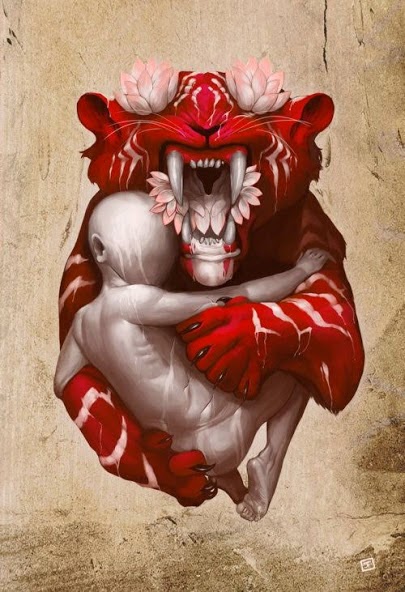
Death, Fighting it, And a Magic Item

I really like +Arnold K. He is one of my first, and my favorite, bloggers. He recently did a sort-of series on death, both mechanics and lore. I really like the Lore bit, but the mechanics aren't very fleshed out, though they have some good Ideas. So I want to put forth my own rules, heavily based on his. Some thing of his I am citing are: the Seven souls, fighting death, spell-souls, and a little bit of the psychopomp roulette. You should go read all the cited posts. They are. Really good. also pretty necessary for the rest of this post
Death can look like anything he goddamn wants.

DEATH

There is one death, or at least on death in a particular area. The local one lives in Muldagha, a cave near Cerulemen, the holy city, about a weeks pilgrimage away. If you find him off duty, you can talk to him (he's nice, sporting, if a bit morbidly distracted). On duty, he's pretty silent, very focused. If you are his duty, there is only two things you can do: fight or flee.

HD: Special. Defences: Saves as cleric, special. Attacks: Rend Body, Rend Soul, Weapon (+5, 1d12+3)
  • A Fighting Chance: Death, paradoxically, loves ambition. He lowers his total hit-dice to the hit-dice total of those who have died before he got there (E.G. if Adam, 2 HD, and Beatrice, 3 HD, died before death arrived, he would roll 5 hit dice to determine hitpoints). He has no it point maximum, and if anyone dies while he is there, he rolls half their HD and gains that many hit-points. 
  • Rend Soul: When fighting against a disembodied soul, this will be death's main attack. The target of this attack makes a a death save, spell save, or DM's choice for the system. The DC for this save will be their highest ability score, or their own spell DC, whichever is higher. Clerics, priests, and other holy men get advantage on this save. Warlocks, cultists, and others who deal with dark powers get a disadvantage on this save. If the target has a fighting spirit, or person or cause they would die for, they receive advantage. If the opposite is true, they are nihilistic and anchorless, they recieve disadvantage. If the target fails the save, they lose one of their high souls (see This). The high souls are lost in order, so essentially you'll: first lose spellcasting (+4 magic save), then goals, then personality, then memory. These souls travel to the afterlife individually. More on that later.
    Who could say "Not Today" to those puppydog eyes?
  • Rend Body: If a soul has avoided death for long, defeated death more than a few times, or is really just a jerk about it, Death will use Rend Body as its main attack. Target makes a Death save, or (DM's choice) save. If the target's physical scores are, in total Higher than 45, they have advantage. If their scores are below 25, they have disadvantage. If they fail, they lose one low soul (see link above), randomly (d3). The effects are this: 
  1.  Lose all self-preservation, assuming you make it back to your body
  2. Lose cellular function, die in 1d6 hours. Immunity to poison
  3. Lose chemical interaction, die in 1d6 minutes. Immunity to transformation.
  • The Dying of the Light: Death's HD, Spell DC, and AC (AC Starts at 13) is modified either in a fiboncci way, increasing each time (1st time, +1. 2nd time, +1. 3rd, +2. 4th, +3. 5th, +5), or in an additive way, each time adding the number of times to the bonus (1st, +1. 2, +3. 3rd, +6. 4th, +10. 5th, +15.), DM's choice.
  • "Please let us out of Stat-block Hell" "No"
  • Life Saver: When cast on a creature currently fighting death, certain spells are very effective from the outside. Gentle Repose or a like anti-decay spell creates an extra-spiritual space in which the spirit can hide for the duration. The fight is essentially put on pause for a few days. No other spell can affect the spirit or their fight with death until they leave. The spirit may leave at any time, though doing so resumes their fight with death. Spare the Dying or a like stabilization spell reduces death to 3/4 his current hit points, or he saves and is only reduced to half. Revivify and other partial Resurrection spells banish death, bringing the fallen back to life, returning all Low Souls and 1 High Soul (chosen by the caster, assuming each is willing). True Resurrection does the same, but restores all souls (assuming each is willing).
Mary H. Magdalene, this is a wall of text! TL;DR: He has your collective hit dice; he removes your souls; spells and mind first, then body; he gets harder each time you beat him; and select spells hurt him.
This guy's PREPARED

What Happens After You Beat Him

Congrations! You are alive (assuming you didn't lose 3 or more souls)! Roll under Constitution to get up at 1 HP, otherwise you are unconscious and stable.

And if I did Lose a Few Souls?

I've already stated what happens if you lose your three low souls, Animal, Vegtable, and Mineral. (see Rend Body. Good news, losing those means you can't be a zombie, because you don't have the necessary components). They also affect the physical stats (Dex, Con, Str respectively), so losing these gives disadvantage on checks for those stats. High souls are more fluff, less crunch. The four high souls (Purple, Red, White, and Blue) correspond to the three mental stats + spellcasting (Int, Cha, Wis, Spells respectively) the same way the low souls do, though losing the blue soul simply means you can't cast spells. 
More interestingly, losing high souls affects your character's personality. (if you haven't read the lore post by Arnold, you really should now. everything will make more sense. please. at least read the bottom section) In 5e Terms, losing Purple removes your character's bond, losing Red removes their personality trait, losing White removes their Ideals. Blue is a bit weird. Arnold describes it as the connection to the divine, and to spellcasting. For 5e, the only character trait left is their flaws, which I guess you could do if you wanted? It gives wizards a reason for weird, and makes the next bit more interesting.

This is Bad, I Want them Back!

The closest you'll get is to replace your soul(s) with a spell. Casting the spell Imbue Living Spell (called Imbue Homunculus in the source) replaces up to 4 missing souls with a cantrip or 1st level spell the caster knows, has currently prepared, or has a scroll of. The caster can no longer cast that spell until the soul is removed, unless the spell was in a scroll, which is destroyed. This has different effects based on which souls were replaced
Don't replace TOO many
  1. Replacing the blue soul replaces one of their spells with the spell they've been given, and they must always prepare it. (E.G. the warlock knows two cantrips, and has his blue soul replaced with mage hand. Hence, he knows 1 cantrip+mage hand. The wizard knows 6 level 1 spells, and can prepare 4. His blue soul was replaced with detect magic. He then only knows 5 Level 1 spells + detect magic and can only prep 3+detect magic.) If a character has no spellcasting, he can cast the spell 1/day as a spellcasting class of his choice of his level. If the spell has a duration, the caster cannot cast spells for the duration (and also loses the benefits of the other souls the spell has replaced). The spell also replaces the character's flaw. It should be thematic. If you used Mage hand as a soul, it could make you wayyyy too grabby, or maybe a charm person soul makes you insufferably pompous. Or you could just be obsessed with casting that spell.
  2. Replacing the white soul changes their goals (ideals if you are playing 5e). They now hold something thematically related to the spell as something they always want and strive for. Maybe they get sleep and always strive to reduce work, or they get prestidigitation and strive to impress people.
  3. Replacing the red soul changes their personality, the little things about them. They essentially act a little more like their spell superficially. Sacred flame makes them act holy, magic missile makes them act pointedly.
  4. Replacing the Purple soul make it a bit interesting, as this soul is tied to memory. They now have the memories of the spell, of the ether and the place beyond, where books are before they're written. They also have memories of the inside of the magic user's head, though its incomprehensible. (if you are playing 5e, replace the bonds section with some connection to an extraplanar entity, like a ghost) Considering this was the last soul to be lost, there is likely no leftover bits of the PC. You've constructed the Ship of Theseus. Re-roll all the mental stats and choose new spells.
  5. Replacing the animal soul changes the instincts of the character. These instincts are alien, so it'll seem a bit lolrandom. The character's understanding of what is necessary changes: they might not think food is something they need (they still do), they might think they'll die if they can't look through a telescope. It also changes some of their physical appearance. Hair, eyes, and mucous membranes (mouth, sclera, nostrils) will change color. Certain parts will go out of proportion. At this point, they should be dead, and they show it.
  6. Replacing the Vegetable soul changes the physical subtly, but drastically. Their flesh may become a different material, like petals or iron (though this has no effect on AC or HP and is, in many cases, the same color as the original flesh). They may also grow horns or antlers, though this is rare. Their body, though it may appear human or humanoid, is biologically completely different. They may not even have cells. While the animal soul changes what they think they need, the vegetable soul can change what they actually need.
  7. Replacing the Mineral soul is insane. The subject's subatomic particles no longer belong in the world. They can look completely human, but they might be made of neutrinos. A lot of the time, the world around them just completely rejects them. When the mineral soul is first replaced, the they must make a save or die instantly, erased from reality. They must remake this save every time they face Death, an Inevitable, or any other manifestation of universal truth and law.