Saturday, October 9, 2021

Darklings (Hypogeum)


A Darkling I encountered, who distinguished himself with a stately Tricorn. Unsettling, but amiable.
Darklings are inhabitants of the Hypogeum. They are, as I have previously said, seemingly related to Folk, and many possess carapace-like skin, or else are vaguely insectoid. They are generally more serious, dour, and skillful than the folk, though there are, of course, myriad exceptions. They possess a cultural inclination towards concealing clothing. This, and their already exterior, lends them the general appearance of two eyes on a spindly-limbed silhouette. But this is all common knowledge.

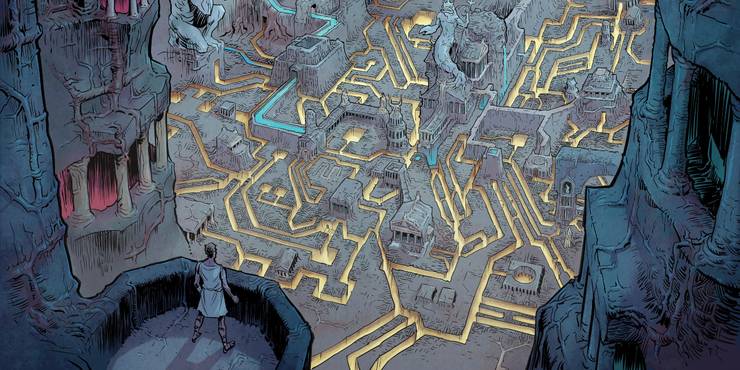
Where Folk are at their height of civilization with a town, Darklings have Cities. It is unknown whether the Darklings built their cities, or whether they were part of the Hypogeum from the start, but they are certainly fantastic. Most theories say that it was an original part of the Hypogeum, since the materials used to make them don't seem to have been mined or scavenged from the maze around them. They are gothic structures, very pointy and solemn. They are expansive, with many skyways and underground (well, "sky" and "ground") passages. Many Darklings never go outside in their lives.

Darklings are able to sustain themselves mostly without farming by, ironically, hunting and pastoralism. Darklings only inhabit sections (called "Stasarae", "Dwells", or "Abiders") of the city at a time, cycling through the whole city slowly while the rest are overrun by shadowbeasts and other creatures, which they hunt. As well, they herd herbivorous creatures through the Stasara to eat the moss that accumulated there since it was last inhabited. This almost exclusively carnivorous diet, as well as the skill needed to hunt shadowbeasts, has given them a fearsome reputation. Some folk even believe that Darklings became all dark and carapaced because they relied so much on darkbeasts for food.

While some darklings herd and hunt, many are more scholarly. Scholars study the notes left by previous generations on the walls of the the Stasara. They are in the process of continual archaeology: they come to a Stasara, study the murals and artifacts, write their findings as well as new developments down in the form of murals and artifacts, and move on. Darklings are secretive to one another, and very cryptic, so by the time that the tribe returns to the same place, the information written there was likely lost, and becomes new information. Every piece of writing on every wall becomes a fragmentary history of the entire civilization told by hundreds of authors.

Darklings similarly are as opaque as possible about their romance, though I do believe they have one. To them, seemingly, all romance is equally taboo, but all of them break that taboo as quietly as possible. Knowledge of both parents is rare. Depending on the community, either the mother raises them in conjunction with all the men (and others) of the community, a child is taken in by a mentor figure (who might or might not be their parents), a single communal parent or parental group raises all children, or the community as a whole raises them. The most brazen Darkling might leave a note as their tribe migrates to the next Stasara, and the child might find it when they are older or if they range far.

Like Folk, they work for the most part on a barter system, with every treasure approximately worth the same as every other treasure, and food mostly shared. However, Darklings are much more likely to have specific and obvious preferences. A certain Darkling might collect swords, while another collects hats, while still another collects artifacts of human culture, or skeleton bones! Though, perhaps he only wants to inter them. Even Darklings who are not relicseekers collect, though obviously relicseekers are more common among them. They won't trade the things they collect things away, but they'd give you a treasure for things that might otherwise be trash, or several treasures for one otherwise valuable.

This tendency for collection, and as well, for creation (for darklings like to make fine things), means that their tombs often contain goods important to them in life. While most treasures will be redistributed to the community, the most important treasure to a certain darkling will often be left with them in a Stasara. They believe that it takes until the tribe cycles back to the Stasara for all the life and magic in the body to dissipate, and to reclaim it before hand is disrespectful and dangerous.

If it wasn't apparent, Darklings do not bury their dead. They allow scavengers, mold, and moss to overtake it, leaving the body in the stasara but otherwise in the open. When they return to the stasara, they might clean up the remains (bone and carapace), putting it in a neat pile, if it is already fully clean. If moss lingers on it, they allow the creatures they herd to eat the moss and any remaining flesh, before cleaning it up the same. Or they might throw out the bones, or use them for divination, or use the carapace as further armor (which does not help their reputations). 

As stated elsewhere, the religions of Darklings are apparently more complex than their Folk counterparts. While they revere much the same natural forces, they more often personify them, or worship their servants and great ancestors. For instance, a cult of the Moss I encountered venerated the Great Teacher, whose words brought forth lush spores on an otherwise barren city, as well as his disciple, the First Shepherd. They do not, as a whole, believe in an afterlife, but they might believe that their force might be honored or placated by reminding it of the good relations they have had with it. They tend to pick a statue present in a certain Stasara and

The majority of Darklings are at least henotheistic. They are more aware than their Folk counterparts of the existence of others devoted to other Forces, whether or not those Forces are real or worthy. Notable groups are those that venerate all the forces, called the Arites, and those who reject them all, the Tergites (both pronounced with the e on the end). The Arites are known for their decoration of the cities in which they live, with many-colored prayer flags and many statues festooned with decorations and offerings. The Tergites are known for their iconoclasm and for their music and games, which, divorced from their religious context, have developed in ways both good and bad.

(The statues found in the Hypogeum only sometimes depict certain races. Just as often, they are abstract. Some cults favor statues of certain races. Its not known why.)


Traincrawl: Coldward


Traincrawl is a one dimensional depth crawl by SunderedWorldDM. I'm writing the coldward half of this depth crawl, away from the engine and toward the caboose1, while my Collaborator, whom I have worked with Before will be making the engineward half. The following three tables are depth tables, invented by cavegirl (from whom I have also stolen some entries on these tables). When you enter a new car, roll a d6 on both tables, adding the distance in number of cars from your starting car (so the first car you explore will be +0, the second +1, etc.). Every car has a 2 in 6 chance of being semi-permanently inhabited, and each inhabited car has a 50% chance of having a party and a 50% chance of having a murder mystery. If the car cannot be feasibly inhabited by humans, elfs live there

Car:

  1. Boxcar
  2. Seating Car (Six seats wide)
  3. Seating Car (Four seats wide)
  4. Sleeping Car
  5. Dining Car
  6. Observation Car
  7. Aquarium
  8. Bar
  9. Meditation car
  10. Medical Car
  11. Freezer Car
  12. Tomb Car
  13. Cryocar
  14. Research Car
  15. Ritual Car
  16. Dessert Car
  17. Palace Car
  18. Garden Car
  19. AI Car
  20. Caboose

 Details:

  1. Empty
  2. Graffiti'd
  3. Odd Aspect Ratio
  4. Maintained
  5. Guarded
  6. Dead Scavengers
  7. Cold
  8. Sedate
  9. Impervious
  10. Filigreed
  11. Automated
  12. Ticket Check
  13. Frozen
  14. Laser Turrets
  15. Stabilized
  16. Open Window
  17. Opulent Party
  18. Crystalline
  19. Bose-Einstein
  20. Perfect

 Encounters:

  1. Empty
  2. Scrappers, outgoing
  3. Scrappers, returning
  4. Broken Servitor
  5. Strong Wind
  6. Hypothermic Dabbler
  7. Elf Rescue Team
  8. Mummy
  9. Mobile Ice Crystal
  10. Functioning Servitor
  11. Ice Wizard
  12. Glass Butler
  13. Polar Bear
  14. Glass Birds
  15. Remorhaz
  16. Confection
  17. Elf Bacchanal
  18. White Queen
  19. Sentient Ice Crystal
  20. The Great Intelligence

Descriptions forthcoming, probably in the other 3 collab posts remaining in GLoGtober.

1Caboose is a silly word

Thursday, October 7, 2021

GLoGtober 7: Index Card

At the end of the first week of GLoGtober, how about a Card (or really, a page) to Index the posts I've made so far? I'll update it as I make new posts for GLoGtober, and maybe I'll expand it to include my whole archive. Lazy? Yes. Underwhelming? For the moment. Technically fulfills the criteria? I guess, but I'll probably up my game and redo this prompt if I'm gonna snag that "Completionist Nerd" Badge

Sometimes, one must make the Egyptians and Punt

GLoGtober 6: Playing War (hypogeum)

[image pending]

As previously stated, Folk play a game called War. Well, game is a light term for it, but it certainly isn't actual war. They treat it a bit like it is, though. Each Folk village has a sort of platform or rostrum near its center. Sometimes it is used for orating (ambitious humans be warned, get in the Folk's graces before trying to get up on there, or you will be heavily accosted). But when Folk formally declare War, it is used as a Goal area. The goal of the game is to get some items, called gazae, from the opponents rostrum to yours, while protecting your own items. Opponents will negotiate the gazae to be warred over, but most often it is some treasures. The game will either last a predetermined amount of time, or until a certain number of the opponent's gazae have been scored. The gazae can be scored back by retrieving them from your opponent's rostrum. Human readers will notice some similarities between this and Capture the Flag.

There aren't any rules regarding capturing opponents, aside from "do whatever you can to incapacitate them" and "try not to kill them". Part of the terms of negotiations is whether players can use their treasures, whether the gazae or items outside the game. Most of the time, players can use gazae but not items outside the game, because to use the gazae they must be taken into the opponent's territory, and opponents might then use those gazae themselves. 

Sometimes the gazae is more symbolically important, such as the force of their shrine or symbolic items, like a beloved statue. Sometimes the gazae are mere tokens. Sometimes those tokens signify important things, like rights to use a piece of land, or vassalage. Villages get to keep the gazae they capture, and these are either kept communally or given to the participants who did the most to get them.

The practice of War is very important. Refusing a war outright is a shame on a village, while cheating at War shows other villages that they are not to be trusted. War shows off the accomplishments of a village, while providing the opportunity for less powerful villages to get needed assets. It also, obviously, provides a way to settle conflict, as well as test defenses and strategy. Any race can participate in War, often in specialized roles.

Also its pretty fun.

Wednesday, October 6, 2021

GLoGtober 5: Cultist (Hypogeum)


A Folk cultist approaches the Flame with trepidation

The faiths of folk are predictably simplistic, and perhaps monotheistic, revering a force of nature above others, often enshrining a representation of such attended by a priest or cult. The Flame, the Moss, the Dark, and the Maze are all common faiths. Each village is dominated by one, and Folk of different faiths tend to pretend other faiths don't exist. A devotee of the Dark and a devotee of the Flame, if they were to talk and broach the subject, seem almost not to notice that the other is talking about a completely different force. Even discussions of aspects of the force get parsed into their native faith. Its really kinda weird.

Darklings have a more complex faith, seemingly based on the same thing. They actually recognize other faiths and have theologies encompassing them. Again, they generally view one force as supreme, and other forces as either subservient or malign. While this is generally true, Darklings of some places revere all these forces, while Darklings of other places shun all of them. As well, Darklings are more prone to personification and a more personal religion, as well as more structure.

The signifiers of a devotee are usually distinctive. Often a garish hat or patterned "robes"; sometimes facepaint or a mask. You can tell when a cult is about when you see lots of folk with the same thing on, which is different from those around them. Folk devotees don't seem to have much fervor, beyond reciting some catchphrases (for fun?). Darklings are more secretive and devout. A folk cult is basically just a fun club. A Darkling cult is a serious investment in philosophy.

Link to Class

GLoGtober 4: Exploring the Hypogeum


The Hypogeum is a world which consists of an underground complex (though whether there is any ground for it to be under is a matter of some debate). It can be thought of as a series of linked, immense, cathedral-like caverns, honeycombed with room-like divisions, and rooms below and in the walls of this "central" structure. Sort of like a hedge maze with basements in a roofed courtyard of an circular apartment building. If you make it to the wall, there's probably a door which can take you about three rooms deep in the wall, maybe more or less, maybe connecting to another "courtyard". These courtyards are miles across, and contain both many structures and lots of empty space.

Exploring the "overworld" traditionally (room by room) is both tedious and unnecessary. Traps are rare, and most of it is just empty space, as said before, and it is very possible (though somewhat risky) to just go above obstacles by climbing the walls (aerial predators exist and going above the walls makes you more visible to monsters in the rooms around you). Generally, its dangerous monotony dividing settlements, ruins, and other important structures, with encounters and weather. Which means it can be modeled as a wilderness!

The above is the working hexflower for the Hypogeum. I am dissatisfied with it currently, but what can you do?

Key:
👾 - Monster, or monsters
⚙️ - Puzzle, blocking a site containing (roll as though exploring)
👑 - Treasure
🏛️ - Dungeon
🛖🛖🛖 - Village, a settlement in an open-ish area, often Folk
🛖 - Solitary NPC, a master of some kind or an eccentric
🌿 - Overgrown area
⛲ - Fountain or a safe area
💧 - Flooded area 
📜 - Ruins, uninhabited non-dungeon site
⛩️ - Gate
🌁 - City, or settlement among megastructure, often Darklings

Normal (non-weighted) hexflower rules. You can backtrack to places you've been before, and you can't always explore further in a certain location. 

[Might add examples, or change things around here, but I'm a bit behind right now.]


Sunday, October 3, 2021

GLoGtober 3: Orbs and Everything Else (Hypogeum)


Orbs

As I wrote about in my Previous Post, it is believed there are three prime substances in Hypogeum: Stuff, Life, and Magic. I wrote there mostly about the movements and behaviors of Life, but here I will talk mostly about the behavior of magic. Like Life, Magic can be either found in a pure, gaseous state, or dissolved into another material. As well, Magic has a material memory like Life. This memory takes the form of Spells.

Orbs are a shape of stuff which is good at absorbing Magic. The type of stuff the orb is made of might have some affect on this ability. Certainly, the type of stuff it is made of affects the spells it is predisposed to. Orbs made of a once living material, like bone or wood, cast spells related to the magic present in the being it was procured from. Orbs might have this sort of intrinsic property if made from another magic containing material.

Other orbs are made from materials which don't normally contain magic, or which have had their magic fully drained or purged of its memory. Crystal is most favored for this (see below). Into such a blank orb is placed a seed spell, which can thenceforth shape the magic absorbed into it. This process of shaping can affect the appearance and form of the orb naturally, or very learned people can try to modify an orb to be more suited to a spell or class of spells. This makes the variety of orbs we find in the world.

Orbs, like swords, might not be made of specific type of stuff, but instead be made out of Orb. These can be found commonly, and might be blank, but more often have a spell in them.

Crystals

Crystals are both a shape and a type of stuff. They are ordered and regular. A cubic crystal forms cubes naturally. A pointy crystal forms points, given more stuff to work with. Despite this natural tendency toward one shape, most crystals can be formed into orbs manually, with some skill and persistence.

Crystals are valuable for one property of theirs: It takes considerable effort to get magic in and out of them. This may not seem like a good thing, but it means crystals are often naturally magical blanks, and if you can get pure magic in them, they store it without turning it into spells. It isn't that difficult to do, its just harder than natural processes allow most of the time. If you find a magic crystal out in the wild, that means either someone put it there, or something really magic happened there once upon a time.

Crystals are used in jewelry and art objects for three reasons: firstly, and obviously, its pretty; secondly, it makes good magic item batteries, making the objects useful; and thirdly, for safety. Magic infused crystals glow, and crystals inset into magical objects become infused. If you are handed a fancy thing, you can tell its not magic (thereby, not cursed) if it has crystals that aren't glowy. Still makes it hard to tell if you are being cursed by a magic item, but at least you know that some random jewelry isn't going to curse you.

You could, of course, just use crystals as light sources. Many people do, especially in areas with lots of them. Adventurers who are sorcerers or relic-seekers use them very often.

Runes

Runes are another shape of Stuff. They are very bad at storing magic in general. However, each rune is alright at storing one specific spell. Magic with any other spell memorized, or no spell memorized, simply slides off it. Magic with a memory is very rare in natural, ambient conditions, so just carving a rune and leaving it out won't attract the specific spell it is attuned to. The spell must be transferred to the rune. 

Most runes are carved into other materials. These runes are durable, but can't hold almost any magic. Some runes are written on other materials with ink. These are both less durable and have less capacity than carved runes. Some inks are very good at storing magic, and so have higher capacity than carved runes. 

The best practice, many say, is to scribe with this magic-storing ink on very magical paper or vellum, making a scroll. Scrolls can basically hold a whole spell, both energetically and mnemonically, but casting the spell drains the stuff of magic, which has the same effect as removing all the water in a sand castle. 

Some scrolls exist in the Hypogeum, but they are very rare, and runes aren't used very much in the current era. The most research about them is done in darkling settlements. Scrolls in general are very basic looking, showing a single large rune. Runes also form naturally, as described above, on some spell containing items, like orbs.

Books

Just like scrolls, books aren't common in the Hypogeum. Most Folk aren't much for literacy, but if they are, they paint things on hard tablets or walls, or carve it in clay, or do other things besides. Its simply too damp to make books feasible. However, they do exist.

Books are sometimes brought in by Humans and other otherworlders. These are written in glyphs that only humans can read, and are generally worthless in the hands of others, unless they are collectors. However, some books written by humans are dangerous things known as "poetry", a kind of tool used by humans to enhance their already silver tongues. Poetry read by humans can be intoxicating, and can rival magic in terms of its ability to affect Folk. Some writings in ruins or dungeons have been identified as poetry by human explorers, lending further credence to the theory that humans were the original inhabitants of the Hypogeum. These ruin poems are known for their ability to make any meaning to them impenetrable to all but the most clever and free-thinking Folk (PC Folk).

Books can also be found, rarely, as treasures. Like all treasures, these seem apparently native to the Hypogeum. Often they have a large rune on the front. If the book is a relic, the rune is an indicator of the spell contained within. Some wise Darklings have discovered that treasure books have internally consistent language, unique to each book so far as they have found. This has become widely known, though not widely used except by weirdos.

A note on Treasures and Relics: Treasures are valuable things found in the Hypogeum. Among almost all people, it is generally accepted that one treasure is worth mostly the same as another, barring extraordinary circumstances, and not accounting for taste or individual usefulness. If you bring a fancy hat back from your adventures, its valued the same as a magic item or filigreed staff or, indeed, a book. Mostly they are used for sentimental and aesthetic reasons anyways. Relics are items, sometimes treasures, that can be used by Relicseekers and contain an intrinsic spell. The nature of magic in an relic is such that only Relicseekers of a certain predilection can use them. An Orb couldn't be used by a Bookseeker, after all!

Porbal

Portals

[Post Pending]

Wizards (Damn Them)

The magic present in people is diffuse and faint, normally unusable, just the background level of magic in any place. Wizards are people who cultivate magic in themselves. Most of the time, wizards are sorcerers, also called arcanophages. They drink or eat things with lots of magic in them so that they may concentrate that magic. Most often they drink magic infused water, sometimes (incorrectly) called distilled magic. Not everyone does, though. Relicseekers attune their minds to a certain sort of relic, allowing them to use or siphon the magic inside objects.

The heavy use of magic has effects on the body and mind of its users. Both sorcerers and relicseekers gradually are changed and mutated by the presence of magic, in such a way that allows more magic to enter their bodies, and be more easily manipulated. Orb-like organs, maze-like brains, and other mutations allow true wizards to contain many spells discretely, absorb magic naturally, and modify existing spells.

However, learning new spells is difficult. Either new relics or runes must be obtained, or maddening insights must be undertaken. The easier way is to take apprentices. Each person has some faint magic already inside them, and that magic has a memory, and that memory is a spell. Cultivating that magic to the point that a person's natural spell may be cast, and thus learned by the teacher, leaves the apprentice an almost capable wizard. 

Of course, for as many true wizards are out there, there are a thousand middling sorcerers and superstitious relic-seekers, skirting along on not even a basic understanding of the nature and behavior of magic. Such is life.