I really like +
Arnold K. He is one of my first, and my favorite, bloggers. He recently did a sort-of series on death, both
mechanics and
lore. I really like the Lore bit, but the mechanics aren't very fleshed out, though they have some good Ideas. So I want to put forth my own rules, heavily based on his. Some thing of his I am citing are: the Seven souls, fighting death,
spell-souls, and a little bit of the psychopomp roulette. You should go read all the cited posts. They are. Really good. also pretty necessary for the rest of this post
 |
| Death can look like anything he goddamn wants. |
DEATH
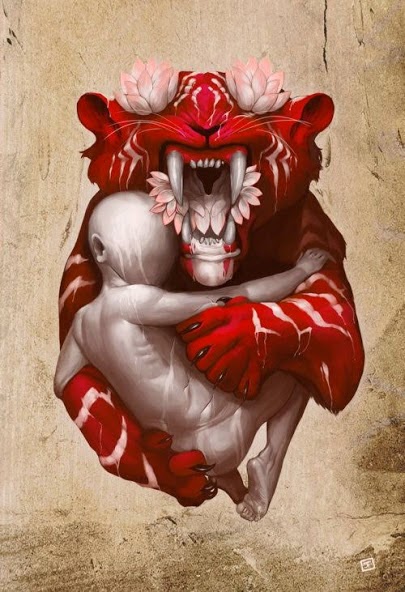
There is one death, or at least on death in a particular area. The local one lives in Muldagha, a cave near Cerulemen, the holy city, about a weeks pilgrimage away. If you find him off duty, you can talk to him (he's nice, sporting, if a bit morbidly distracted). On duty, he's pretty silent, very focused. If you are his duty, there is only two things you can do: fight or flee.
HD: Special. Defences: Saves as cleric, special. Attacks: Rend Body, Rend Soul, Weapon (+5, 1d12+3)
- A Fighting Chance: Death, paradoxically, loves ambition. He lowers his total hit-dice to the hit-dice total of those who have died before he got there (E.G. if Adam, 2 HD, and Beatrice, 3 HD, died before death arrived, he would roll 5 hit dice to determine hitpoints). He has no it point maximum, and if anyone dies while he is there, he rolls half their HD and gains that many hit-points.
- Rend Soul: When fighting against a disembodied soul, this will be death's main attack. The target of this attack makes a a death save, spell save, or DM's choice for the system. The DC for this save will be their highest ability score, or their own spell DC, whichever is higher. Clerics, priests, and other holy men get advantage on this save. Warlocks, cultists, and others who deal with dark powers get a disadvantage on this save. If the target has a fighting spirit, or person or cause they would die for, they receive advantage. If the opposite is true, they are nihilistic and anchorless, they recieve disadvantage. If the target fails the save, they lose one of their high souls (see This). The high souls are lost in order, so essentially you'll: first lose spellcasting (+4 magic save), then goals, then personality, then memory. These souls travel to the afterlife individually. More on that later.
 |
| Who could say "Not Today" to those puppydog eyes? |
- Rend Body: If a soul has avoided death for long, defeated death more than a few times, or is really just a jerk about it, Death will use Rend Body as its main attack. Target makes a Death save, or (DM's choice) save. If the target's physical scores are, in total Higher than 45, they have advantage. If their scores are below 25, they have disadvantage. If they fail, they lose one low soul (see link above), randomly (d3). The effects are this:
- Lose all self-preservation, assuming you make it back to your body
- Lose cellular function, die in 1d6 hours. Immunity to poison
- Lose chemical interaction, die in 1d6 minutes. Immunity to transformation.
- The Dying of the Light: Death's HD, Spell DC, and AC (AC Starts at 13) is modified either in a fiboncci way, increasing each time (1st time, +1. 2nd time, +1. 3rd, +2. 4th, +3. 5th, +5), or in an additive way, each time adding the number of times to the bonus (1st, +1. 2, +3. 3rd, +6. 4th, +10. 5th, +15.), DM's choice.
 |
| "Please let us out of Stat-block Hell" "No" |
- Life Saver: When cast on a creature currently fighting death, certain spells are very effective from the outside. Gentle Repose or a like anti-decay spell creates an extra-spiritual space in which the spirit can hide for the duration. The fight is essentially put on pause for a few days. No other spell can affect the spirit or their fight with death until they leave. The spirit may leave at any time, though doing so resumes their fight with death. Spare the Dying or a like stabilization spell reduces death to 3/4 his current hit points, or he saves and is only reduced to half. Revivify and other partial Resurrection spells banish death, bringing the fallen back to life, returning all Low Souls and 1 High Soul (chosen by the caster, assuming each is willing). True Resurrection does the same, but restores all souls (assuming each is willing).
Mary H. Magdalene, this is a wall of text! TL;DR: He has your collective hit dice; he removes your souls; spells and mind first, then body; he gets harder each time you beat him; and select spells hurt him.
 |
| This guy's PREPARED |
What Happens After You Beat Him
Congrations! You are alive (assuming you didn't lose 3 or more souls)! Roll under Constitution to get up at 1 HP, otherwise you are unconscious and stable.
And if I did Lose a Few Souls?
I've already stated what happens if you lose your three low souls, Animal, Vegtable, and Mineral. (see Rend Body. Good news, losing those means you can't be a zombie, because you don't have the necessary components). They also affect the physical stats (Dex, Con, Str respectively), so losing these gives disadvantage on checks for those stats. High souls are more fluff, less crunch. The four high souls (Purple, Red, White, and Blue) correspond to the three mental stats + spellcasting (Int, Cha, Wis, Spells respectively) the same way the low souls do, though losing the blue soul simply means you can't cast spells.
More interestingly, losing high souls affects your character's personality. (if you haven't read the
lore post by Arnold, you really should now. everything will make more sense.
please. at least read the bottom section) In 5e Terms, losing Purple removes your character's bond, losing Red removes their personality trait, losing White removes their Ideals. Blue is a bit weird. Arnold describes it as the connection to the divine, and to spellcasting. For 5e, the only character trait left is their flaws, which I guess you could do if you wanted? It gives wizards a reason for weird, and makes the next bit more interesting.
This is Bad, I Want them Back!
The closest you'll get is to replace your soul(s) with a
spell. Casting the spell
Imbue Living Spell (called Imbue Homunculus in the source) replaces up to 4 missing souls with a cantrip or 1st level spell the caster knows, has currently prepared, or has a scroll of. The caster can no longer cast that spell until the soul is removed, unless the spell was in a scroll, which is destroyed. This has different effects based on which souls were replaced
 |
| Don't replace TOO many |
- Replacing the blue soul replaces one of their spells with the spell they've been given, and they must always prepare it. (E.G. the warlock knows two cantrips, and has his blue soul replaced with mage hand. Hence, he knows 1 cantrip+mage hand. The wizard knows 6 level 1 spells, and can prepare 4. His blue soul was replaced with detect magic. He then only knows 5 Level 1 spells + detect magic and can only prep 3+detect magic.) If a character has no spellcasting, he can cast the spell 1/day as a spellcasting class of his choice of his level. If the spell has a duration, the caster cannot cast spells for the duration (and also loses the benefits of the other souls the spell has replaced). The spell also replaces the character's flaw. It should be thematic. If you used Mage hand as a soul, it could make you wayyyy too grabby, or maybe a charm person soul makes you insufferably pompous. Or you could just be obsessed with casting that spell.
- Replacing the white soul changes their goals (ideals if you are playing 5e). They now hold something thematically related to the spell as something they always want and strive for. Maybe they get sleep and always strive to reduce work, or they get prestidigitation and strive to impress people.
- Replacing the red soul changes their personality, the little things about them. They essentially act a little more like their spell superficially. Sacred flame makes them act holy, magic missile makes them act pointedly.
- Replacing the Purple soul make it a bit interesting, as this soul is tied to memory. They now have the memories of the spell, of the ether and the place beyond, where books are before they're written. They also have memories of the inside of the magic user's head, though its incomprehensible. (if you are playing 5e, replace the bonds section with some connection to an extraplanar entity, like a ghost) Considering this was the last soul to be lost, there is likely no leftover bits of the PC. You've constructed the Ship of Theseus. Re-roll all the mental stats and choose new spells.
- Replacing the animal soul changes the instincts of the character. These instincts are alien, so it'll seem a bit lolrandom. The character's understanding of what is necessary changes: they might not think food is something they need (they still do), they might think they'll die if they can't look through a telescope. It also changes some of their physical appearance. Hair, eyes, and mucous membranes (mouth, sclera, nostrils) will change color. Certain parts will go out of proportion. At this point, they should be dead, and they show it.
- Replacing the Vegetable soul changes the physical subtly, but drastically. Their flesh may become a different material, like petals or iron (though this has no effect on AC or HP and is, in many cases, the same color as the original flesh). They may also grow horns or antlers, though this is rare. Their body, though it may appear human or humanoid, is biologically completely different. They may not even have cells. While the animal soul changes what they think they need, the vegetable soul can change what they actually need.
- Replacing the Mineral soul is insane. The subject's subatomic particles no longer belong in the world. They can look completely human, but they might be made of neutrinos. A lot of the time, the world around them just completely rejects them. When the mineral soul is first replaced, the they must make a save or die instantly, erased from reality. They must remake this save every time they face Death, an Inevitable, or any other manifestation of universal truth and law.