Showing posts with label history. Show all posts

Wednesday, May 3, 2023

God-kings Rule the World: a Short Response to Cosmic

Cosmic Orrery made a post yesterday about Wizards. 3d6 Polar Bears responded to them. I have a few thoughts on both. Unfortunately, blogger is a glitchy mess and I'm not on the Purple Server, so my comments will have to be extended into Content. Not very long content though.

Cosmic's post elaborates on the theme of Wizards and their Domains, and how well a cyclical model of tiny witch-kings creates to the standard dungeons and dragons milleu. It's perhaps not a totally original idea, but I have never valued originality terribly highly. I prefer things to be well-crafted and thought out, so I welcome a post which makes clear the uses of a setting assumption. My thesis is, I think, similarly obvious, but similarly useful: The Wizards that Cosmic describes don't need to be Wizards.

I mean that they need not be scholarly, old magicians, or even skeletal liches. Rather, one can include quite a variety. Ambitious prophets of gods, dark or light. Sword-Saints with magical blades that can cut down 20 men. Some other third thing. All these are likely to seek out magic and wealth, carve out their domain, and fall like lightning. You could probably call them Wizards if you like. But it seems like the powerful tend to blur into each other. If your sword-saint can summon spirit-lightning, he's not so much different from a sword-using wizard. Kill Six Billion Demons has a lot of examples.

Can you spot the Wizard?

 So maybe it would be better to think of them in more general terms. They are simply the Powerful, the god-kings. Some have a scholarly bent, some make secret deals with awful powers, some use swords, some sneak unseen, all are terribly good at killing. All of them are gonna build weird dungeons, make weird creatures, leave weird artifacts, send you on weird quests, and make satisfying noises when you shank them. History is littered with their bodies.

Wednesday, October 20, 2021

A description of the Heavens (hypogeum)


A sketch of an inhabitant drawn by the Sorcerer

This is an account of an expedition to the ceiling, by this humble creature. We made the usual journey from the village of the blue folk (which stands adjacent the cavernous ruins of the orb) by way of the western fountain path to the wall of the cathedral. Here, we set up a camp. We chose this place for it was known to be traversable vertically, owing to the rooms inset in the wall and the ledges higher up. Other places, the wall-rooms of which did not connect well, were not suitable.

After resting for a time (the lights passing half over the water), we resolved to ascend. The first room contained stairs upwards and downwards, as we had heard (it is said that the stairs down were where the Farmer discovered one of his specialty mushrooms, the one which produces a sweet distinctive taste, which was called by the humans "grape"). Traveling upwards, the way for four rooms was only of interest to a rock darkling, and there were a few other rooms besides which were dead ends. In this section I also discovered a fetching hat. 

As we ascended, the rooms became less tame. They were damp with cloud-dew, and colonized by buoyant moss and the creatures that ate it, and the creatures that ate them. Some of these proved troublesome, such as a darkbeast of the wall-crawling variety (There were few more substantial darkbeasts up here. Infrequent were the flat- or pad-footed beasts, and only sparse the hooved ones). The sorcerer called it a "spidery bastard" and set it aflame (we were lucky it was so damp). Many other things happened which I won't write about.

We eventually were forced out onto the ledges. They were paths wide enough that two could comfortably stand beside one another and have generous room. However, they were dangerous, because of the prevalence of flying beasts and other hazards. These attacks were especially dangerous because of the chance of falling. But we prevailed, in the end, and ascended 4 more levels. When this was done, the roof was in sight. However, in the end there was no way to reach it.

When this became apparent, we began looking for other things to do, since we were in such a special position. The sorcerer (who was a human), and the fighter (a grimalkin) simultaneously spotted a rare sight: an Angel flying about clouds. The rest of us could not see it, and the two who did soon reported it vanished. The two both began speaking very excitedly (one should always plug ones ears when this happens, but I did not). The next thing I knew, we were awkwardly flying towards the last place the angel was seen. I later found out that the sorcerer had drunken three mana potions (our entire supply) to give us this power.

I will not bother with the details of this flight, as I cannot properly render them. But soon we found where the angel had disappeared from and where it disappeared to. Simply, there was a village in the sky held aloft by some kind of balloons. 

Some people who read this might not have seen a balloon or even heard of it. It is a practice done by wizards where they take a special sack and fill it with magic which is lighter than air. This makes the sack float, and it can be tethered with a string and produce mirth. Sometimes a balloon may be made large enough to carry a person into the air for a short time. Humans claim that it is also a practice in their world, and more common than most other magics.

The balloons which held this village were greater, of course, than the balloons anywhere else seen. And this was not the only wonder, for it was evident that there was some illusion disguising the village causing it to be invisible from the ground. And of course there were the people who lived there.

It is a common rumor that there is a sort of human which possesses wings rather than arms and may fly around. It turns out this is true. The humans call these "Angels" (which is what I called it above) or "Harpies". The Sorcerer (who was beyond excited) called them "Ritos". The Sorcerer often says weird things.

They indeed flew around on wings which were their arms. Their legs and feet were dexterous as arms and hands, though the fact that they needed to either sit or balance on one foot made them disinclined to do unnecessary things. They occupy themselves with hunting and maintaining their village.

They hunt for things like aerial beasts, buoyant moss and fungi, as well as ground dwelling creatures small enough to take back to the village. They steal cloth to sew their balloons. They perform the magic that fills them. They gather water that condenses on them to drink. These are their daily tasks.

They are hidden, and free from the influence of the Dragon. They do not revere the forces, for they are humans and do not enter the ruins at all. They live perpetually in anxiety of the failure of their village, for if it does, they will have to hide away in high rooms. Now that we have found them, they will move on so that they are not found. Because of the fantastic nature of their habit and the incredulity of those who live below, they do not object to our speaking about them.

We stayed there for some days, until we left by the same manner as we arrived.

(Translator's note: This text was found in an abandoned village, presumably the "village of the blue folk", hidden in a secret compartment. I have taken many liberties in this translation to make it interesting to human readers, but the main events and descriptions, as well as a few phrases of particular interest, are intact. The veracity of these events is suspect, but I've learned not to dismiss anything)

Sunday, October 17, 2021

Ruins


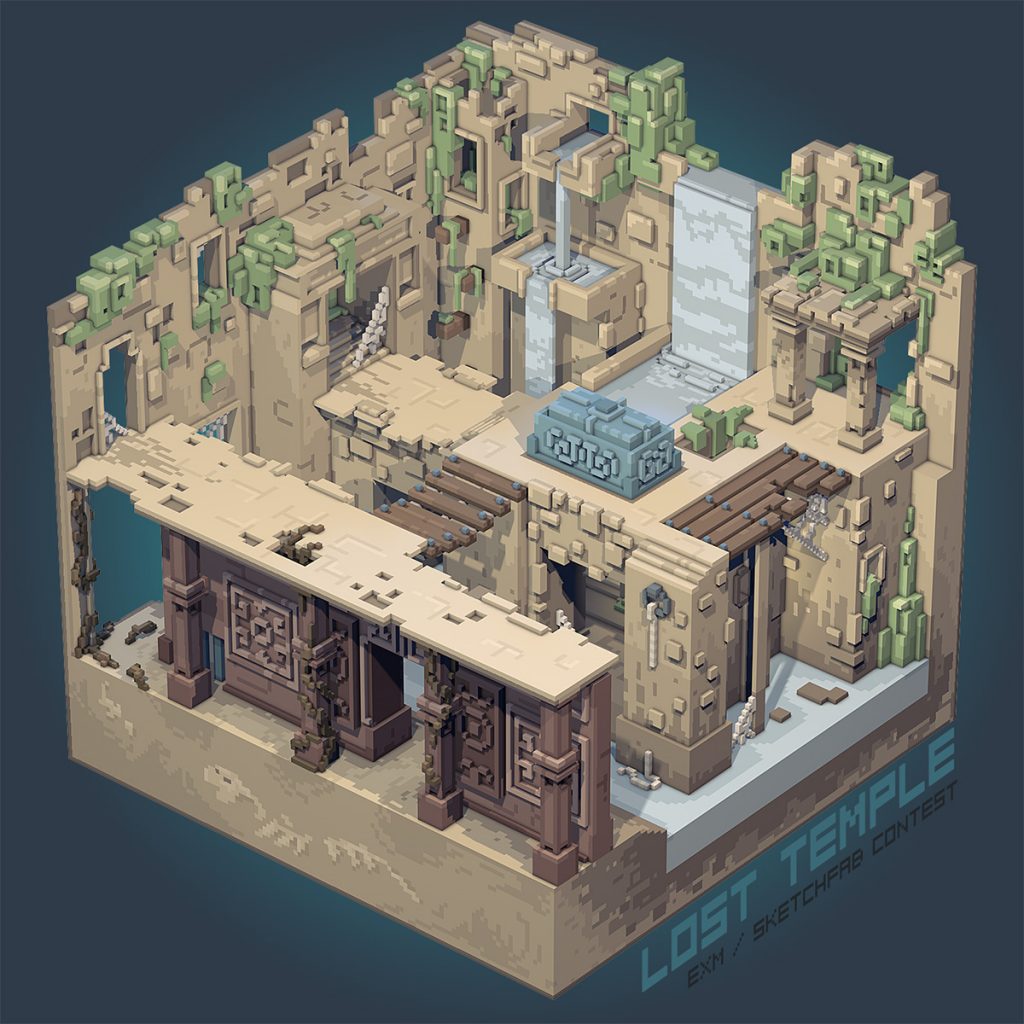
Ruins are spaces considered holy by Folk. Inside them you find things that you would find in the rest of the Hypogeum, only denser. This makes them very hard to traverse. Ruin Complexes are normally circular, or some equivalent, becoming denser and denser as you get towards the center. As such, most people give them wide berth, though being able to go nearer the center would make a nice shortcut. Most ruin complexes are almost a mile wide, and dominate the cavern they are in.

They dominate in more than one way. The presence of ruins in a cavern seems to affect, or at least be a good indicator of, the force that Folk revere. Or maybe the Folk built the ruins in honor of a force they already revered? The Folk are weird about religion, as we all know. That all to say, each Ruin Complex seems devoted to, or at least themed around, one Force. Oftentimes they are also pervaded by that force.

As previously stated, ruins are dense. They are full of puzzles, treasure, and most of all, Lore. Loads of (untranslated) hieroglyphs, murals, and gut understanding. Most of the puzzles and treasure are also lore. The ruins will tell you what a Force is like, what is sacred to it, what it hates, etc. There are also depictions and statues of various creatures, most of which are unidentified, but one of which is the Dragon (see: Dragons, forthcoming). Finally, there will be the Prophecy, that a sacred hero will come out of the ruin and defeat the Dragon.

Some say that the hero already came, and he died. Others say he joined the Dragon. Still others say the Dragon used to be a hero himself. These sorts of confusions come about when you're only going off somewhat abstract pictures.

There are also more mundane secrets besides, like the location of treasures, hidden wells, gates, etc.

Piranesi

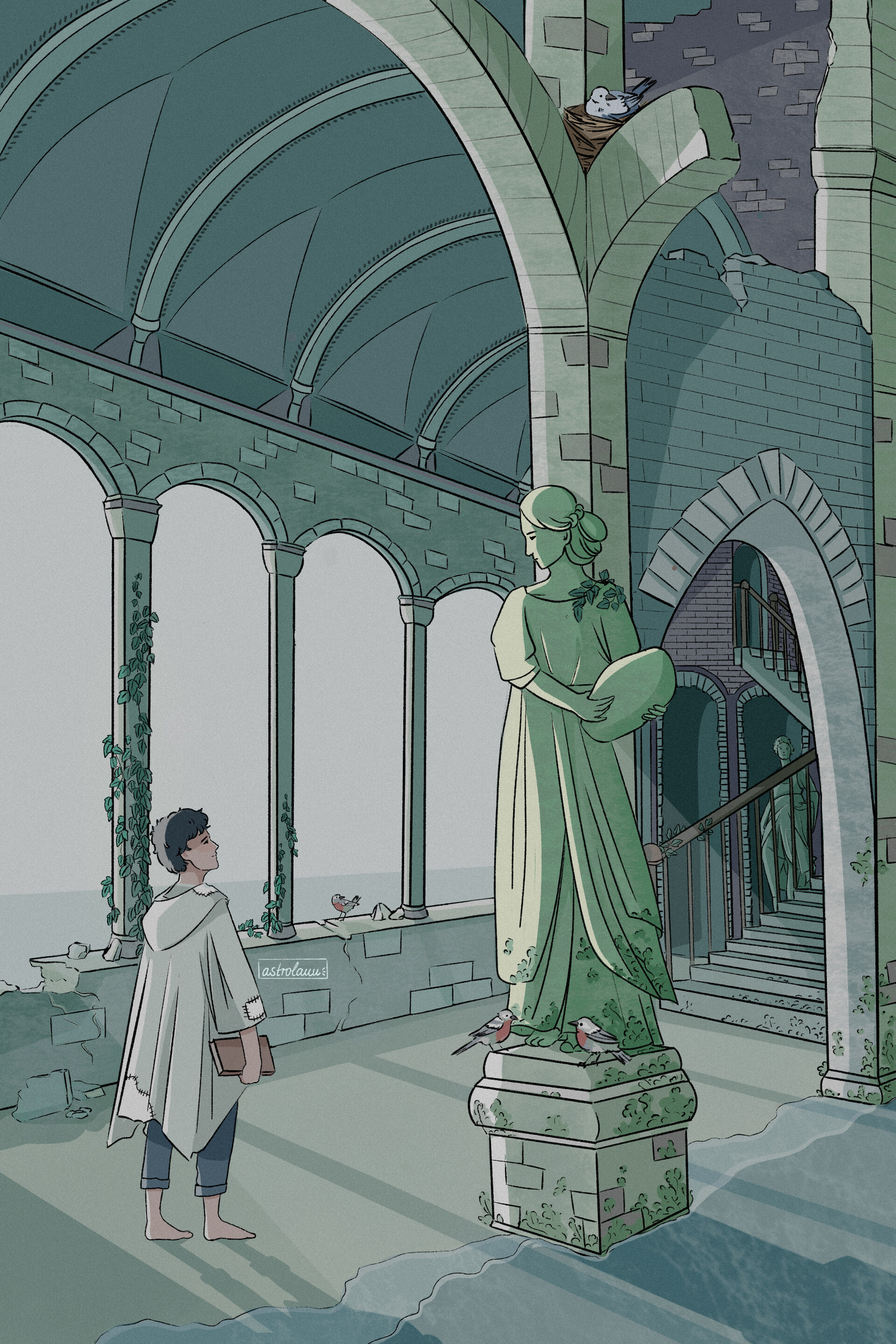
The ruins are haunted by living statues. These can be found rarely in other parts of the world, but, like I said, the ruins are Denser. They also have unliving statues, and the living ones could hardly be called statues. But they move, and they're made of stone, and the name stuck. Like most things made of stone, very difficult to kill. Have a sword artist or sorcerer at the ready, dangerous as they are, those statues are more so.

Don't get caught up in a puzzle, or you'll die.

Voxelmade

Now I said they are holy to the Folk, and its clear that they have some association with Folk religion, but I feel I should expound more upon this. It is a topic of intense debate (as intense as Folk can get) about whether Folk, or anyone, should be allowed in the Ruins at all. One might expect some hassle if one emerges from a ruin in sight of those people who frown upon it, and especially if one is carrying sacred treasures. 

Folk priests make use of the ruins to understand their faith, navigating them through preordained paths and solutions to review specific commands or insights. The knowledge and tradition of these paths is what makes them priests and not just devotees (devotees might be just as holy and authoritative, but lack the knowledge and experience of ages). If a priest is feeling candid, he might show the way to those he trusts, or might simply tell them the information they seek.

Just the same as the debate regarding entrance to the ruins, is the debate regarding the sort of creature the hero will be. Some Folk cannot imagine the hero coming from among their own race, while others cannot imagine them coming from another race.

Darklings for the most part don't take part in these debates. As usual, they are rather secretive regarding their beliefs. Arites seem pretty hopeful about it though.


Thursday, October 26, 2017

Exploring the Elfin Kingdoms

Who's winning the King's War today?

  1.  A powerful and ancient second generation elf, hoping to win the war so he can die and pass the kingdom on to his children (and do it right this time)
  2. A powerful and ancient second generation elf, hoping to win the war so he can achieve true immortality and reign forever with grace and terror
  3. An eminent third generation elf whose father cleverly won land with political marriage and intrigue
  4. An eminent third generation elf whose father won land by attacking his neighbors in dishonorable raids in during the great crusade
  5. An eminent third generation elf who won lands for himself during his youth and has his eyes set on a beautiful princess in a neighboring kingdom
  6. An eminent third generation elf who won lands for himself during his youth and has his eyes set on an plain princess in a neighboring kingdom for political purposes
  7. An eminent third generation elf who won lands for himself during his youth and has his eyes set on a dirt poor and gorgeous human peasant in his own kingdom
  8. A half-elf bastard knight who became a major player through the favor of his king
  9. A half-elf bastard knight who became a major player through sneaky stabby tactics
  10. A Human? What?

No, but seriously, who's actually winning the War?

Witch-Queen Pim is, though none of the other elves will admit it. From her city in the sea, she reigns over all the elves warring upon the land. Her magical power is unmatched anywhere in the world. In the dreamlands, she is next to a god and has deals with the most powerful among the dreamland's sedentary deities. When she steps upon the mainland, the war stops so the elf-kings can lay their coats at her feet.
Average out the above pictures to see what Witch-Queen Pim looks like
[Her kingdom in the sea is pretty cool so I'll write about that sometime]

What is this kingdom like?

  1. Lots of domes and spires. Light pink stone and dark wood. Shepherd peasants live in bright tents. Heath dominates the land.
  2. Sloped Roofs and green-painted wood. Kites affixed to every surface. Peasants work ripe vineyards. Knights wear hand-stitched scarves detailing funeral rites.
  3. Arcades below support gardens above. Streams run in every direction, starting rivers in other kingdoms. Most peasants are grain farmers and are often raided by the neighboring kingdoms.
  4. Buttresses and spines decorate the palaces. Peasants practice forestry and live in cottages. Knights wear the chitin of large spiders.
  5. Crystals adorn turrets and crenellenations. Peasants live below ground and are often miners. Shells are used as currency where gold is common.
  6. Fortified mansions replace palaces here. Peasants most often hunt, so meat is plentiful and eaten undercooked by the nobles. Horns and antlers replace weapons when steel is scarce.
  7. Almost the entire population dwells in decrepit and beautiful ruins. Peasants farm glowing fungus for ethereal elf-bread. Armor still bears groves where runes were writ in the last age.
  8. Roll again, but it's entirely underground. If this result is rolled again, it's further underground.

What menaces this kingdom?

  1. Non-violent heredity squabbles
  2. Violent heredity squabbles
  3. Famine
  4. The elves are killing their human peasants
  5. Big bad monster
  6. Roll twice more. This result can be rolled again. Elf kingdoms suck for humans.

How big?

  1. Literally just a hamlet
  2. 1d4 hamlets, 1 town
  3. 1d4 towns, 1 city
  4. 1d4 cities, 1 capital
As a rule of thumb, they fit in a 6-mile hex. They can be larger, though.
This one is ruled over by King Locrantz. He's kind of a jerk.

Why isn't the witch queen smiting them all now?

No one knows.

Friday, September 1, 2017

The Elfin War

Optional History: The Nephim

The earliest era known to historians of the Great Sea is the pre-marine era, when the earthly sphere was entirely desert, ruled by the goddess Cthon. The nephim were the humanoids designed by the three goddesses to survive the harsh desert and house the most powerful souls. The lesser souls that would become humans solely dwelt in the spheres above and below at this point.

The immortal nephim built the great black pyramids that dot the known lands, and enjoyed prosperity until the fall of Cthon and the creation of the Lords of Pain. After the fall of Cthon, Selene, who had previously ruled the underworld, caused an global ocean to form, far larger than the Great Sea. The nephim who survived on the sparse islands, though their population was less than a thousand, were given human souls from both above and below to rule over. When they ruled justly, they would ascend to the lunar sphere. When they were cruel, they were thrown to the underworld. When Gaia began her era and made the Great Sea, the nephim numbered less than five members.

The Great King Gu

Gu was a good man. Gu was a good warrior. Gu was a good strategist. Gu was, however, a terrible king. 

Gu was the first king after the nephim. He was what people today would call an elf, but there wasn't any distinction back then. Some people just lived longer than others. In fact, Gu is the ancestor to all modern elfs. He conquered, ruled, and seduced half the known world in his 200 years of life. 

At the height of his reign, he ruled over what is now all the human and elfin kingdoms. "Ruled," however, is a tentative term. The extent of his sovereignty was the taxes levied on the various city-states who governed themselves (mostly on the laws of the nephim). The provinces under his control warred constantly, though none dared approach the capital. After his death, his, "empire," shattered.

The root of the problem was this: the kings before him were nephim. No precedent was set for succession, because they were immortal. No precedent was set for enforcement, because they were divinely appointed. So the empire of Gu fell. 

The scholar priests of Selene posit that Gu was born of the unlikely (possibly miraculous) union of a nephim and a human. Thus, they say, he inherited the right of rulership, and passed it on to his children, the elves. It should come as no surprise that Selene is worshiped near exclusively in the elfin kingdoms.


The Thousand Heirs of Creation

Every elf is a bastard. Bastard blood from father to son, grandfather to father (though the length of an elfin generation makes about only 4-5 generations since Gu was alive). But Gu never bore a true heir, one that held the same strength of dominion as he did. So all elves fight for a throne given to no one.

When Gu died, all of his children made a bid for the crown. They seized control of whatever towns they could and went to war. The First Kings War never truly stopped. However, by the second generation, most of the full blooded humans rose up, under the banner of Patriarch Mortimer I, coincidentally the first patriarch, and conquered the holy city of Cerulemen (which was, of course, not holy then) as refugees.

To keep a strong claim, all elves seek to keep their bloodline as pure as possible. To make a half-elf is to waste a child. The first generation was when most of the families lost their claim: while most intermarried with humans, the more cunning/willful/insane pressured the Fatefire Mages. Within a few decades, a spell was devised to entwine an elf soul with chaotic magic, making elves fateless, magical, and unable to produce children with birth defects. Thus were born the True elves, born with fire in their heart from two children of Gu. The incest of the True elves was one of the factors leading to the Crusade of Cerulemen.

After the Crusade, the elf kings (of which there were 40-60)  were left with a few hundred human farmers and a few dozen half-elf bastard knights each. They couldn't levy farmers, especially not anymore, and they couldn't risk their knights. In addition, the human war-machine had begun in the east, conquering the previously elf-held southern plains and killing almost half of the elves there. For a few generations, all the elves could collectively manage was a rather poor defense and a great deal of intrigue.

The Second Kings War

After 400 years, or 3-4 elfin generations, The Kings War slowly restarted. The population of both humans and half-elves under the control of the Elf kings has returned to historic levels, and the Great Crusade has slowed to a crawl due to public disinterest and the fact that it has lasted for 400 years (though, again, technically never finished). Thus, without real outside threat, and now with actual armies, the elves reaffirmed to themselves that, yes, this land belongs to me and hey that guy's land should also belong to me.


Pretty much any elf or half-elf can make a claim and enter the war as a new belligerent. I'll detail mechanics for players making a claim a bit later.


One of the Elf Kings probably turned into this.
[Gotta cite this post for the True Elves and probably some other bits]