Thursday, October 7, 2021

GLoGtober 7: Index Card

At the end of the first week of GLoGtober, how about a Card (or really, a page) to Index the posts I've made so far? I'll update it as I make new posts for GLoGtober, and maybe I'll expand it to include my whole archive. Lazy? Yes. Underwhelming? For the moment. Technically fulfills the criteria? I guess, but I'll probably up my game and redo this prompt if I'm gonna snag that "Completionist Nerd" Badge

Sometimes, one must make the Egyptians and Punt

GLoGtober 6: Playing War (hypogeum)

[image pending]

As previously stated, Folk play a game called War. Well, game is a light term for it, but it certainly isn't actual war. They treat it a bit like it is, though. Each Folk village has a sort of platform or rostrum near its center. Sometimes it is used for orating (ambitious humans be warned, get in the Folk's graces before trying to get up on there, or you will be heavily accosted). But when Folk formally declare War, it is used as a Goal area. The goal of the game is to get some items, called gazae, from the opponents rostrum to yours, while protecting your own items. Opponents will negotiate the gazae to be warred over, but most often it is some treasures. The game will either last a predetermined amount of time, or until a certain number of the opponent's gazae have been scored. The gazae can be scored back by retrieving them from your opponent's rostrum. Human readers will notice some similarities between this and Capture the Flag.

There aren't any rules regarding capturing opponents, aside from "do whatever you can to incapacitate them" and "try not to kill them". Part of the terms of negotiations is whether players can use their treasures, whether the gazae or items outside the game. Most of the time, players can use gazae but not items outside the game, because to use the gazae they must be taken into the opponent's territory, and opponents might then use those gazae themselves. 

Sometimes the gazae is more symbolically important, such as the force of their shrine or symbolic items, like a beloved statue. Sometimes the gazae are mere tokens. Sometimes those tokens signify important things, like rights to use a piece of land, or vassalage. Villages get to keep the gazae they capture, and these are either kept communally or given to the participants who did the most to get them.

The practice of War is very important. Refusing a war outright is a shame on a village, while cheating at War shows other villages that they are not to be trusted. War shows off the accomplishments of a village, while providing the opportunity for less powerful villages to get needed assets. It also, obviously, provides a way to settle conflict, as well as test defenses and strategy. Any race can participate in War, often in specialized roles.

Also its pretty fun.

Wednesday, October 6, 2021

GLoGtober 5: Cultist (Hypogeum)


A Folk cultist approaches the Flame with trepidation

The faiths of folk are predictably simplistic, and perhaps monotheistic, revering a force of nature above others, often enshrining a representation of such attended by a priest or cult. The Flame, the Moss, the Dark, and the Maze are all common faiths. Each village is dominated by one, and Folk of different faiths tend to pretend other faiths don't exist. A devotee of the Dark and a devotee of the Flame, if they were to talk and broach the subject, seem almost not to notice that the other is talking about a completely different force. Even discussions of aspects of the force get parsed into their native faith. Its really kinda weird.

Darklings have a more complex faith, seemingly based on the same thing. They actually recognize other faiths and have theologies encompassing them. Again, they generally view one force as supreme, and other forces as either subservient or malign. While this is generally true, Darklings of some places revere all these forces, while Darklings of other places shun all of them. As well, Darklings are more prone to personification and a more personal religion, as well as more structure.

The signifiers of a devotee are usually distinctive. Often a garish hat or patterned "robes"; sometimes facepaint or a mask. You can tell when a cult is about when you see lots of folk with the same thing on, which is different from those around them. Folk devotees don't seem to have much fervor, beyond reciting some catchphrases (for fun?). Darklings are more secretive and devout. A folk cult is basically just a fun club. A Darkling cult is a serious investment in philosophy.

Link to Class

GLoGtober 4: Exploring the Hypogeum


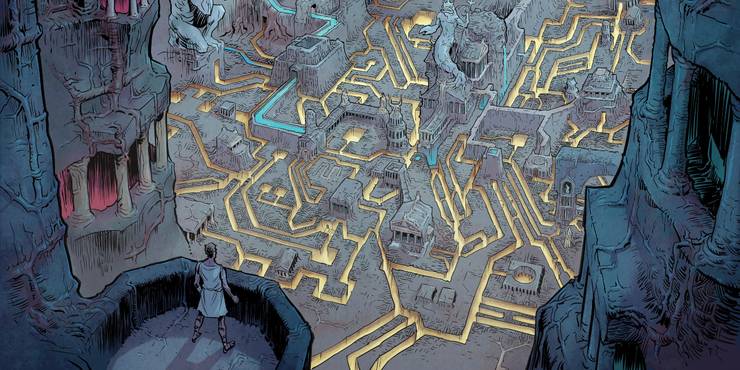
The Hypogeum is a world which consists of an underground complex (though whether there is any ground for it to be under is a matter of some debate). It can be thought of as a series of linked, immense, cathedral-like caverns, honeycombed with room-like divisions, and rooms below and in the walls of this "central" structure. Sort of like a hedge maze with basements in a roofed courtyard of an circular apartment building. If you make it to the wall, there's probably a door which can take you about three rooms deep in the wall, maybe more or less, maybe connecting to another "courtyard". These courtyards are miles across, and contain both many structures and lots of empty space.

Exploring the "overworld" traditionally (room by room) is both tedious and unnecessary. Traps are rare, and most of it is just empty space, as said before, and it is very possible (though somewhat risky) to just go above obstacles by climbing the walls (aerial predators exist and going above the walls makes you more visible to monsters in the rooms around you). Generally, its dangerous monotony dividing settlements, ruins, and other important structures, with encounters and weather. Which means it can be modeled as a wilderness!

The above is the working hexflower for the Hypogeum. I am dissatisfied with it currently, but what can you do?

Key:
👾 - Monster, or monsters
⚙️ - Puzzle, blocking a site containing (roll as though exploring)
👑 - Treasure
🏛️ - Dungeon
🛖🛖🛖 - Village, a settlement in an open-ish area, often Folk
🛖 - Solitary NPC, a master of some kind or an eccentric
🌿 - Overgrown area
⛲ - Fountain or a safe area
💧 - Flooded area 
📜 - Ruins, uninhabited non-dungeon site
⛩️ - Gate
🌁 - City, or settlement among megastructure, often Darklings

Normal (non-weighted) hexflower rules. You can backtrack to places you've been before, and you can't always explore further in a certain location. 

[Might add examples, or change things around here, but I'm a bit behind right now.]


Sunday, October 3, 2021

GLoGtober 3: Orbs and Everything Else (Hypogeum)


Orbs

As I wrote about in my Previous Post, it is believed there are three prime substances in Hypogeum: Stuff, Life, and Magic. I wrote there mostly about the movements and behaviors of Life, but here I will talk mostly about the behavior of magic. Like Life, Magic can be either found in a pure, gaseous state, or dissolved into another material. As well, Magic has a material memory like Life. This memory takes the form of Spells.

Orbs are a shape of stuff which is good at absorbing Magic. The type of stuff the orb is made of might have some affect on this ability. Certainly, the type of stuff it is made of affects the spells it is predisposed to. Orbs made of a once living material, like bone or wood, cast spells related to the magic present in the being it was procured from. Orbs might have this sort of intrinsic property if made from another magic containing material.

Other orbs are made from materials which don't normally contain magic, or which have had their magic fully drained or purged of its memory. Crystal is most favored for this (see below). Into such a blank orb is placed a seed spell, which can thenceforth shape the magic absorbed into it. This process of shaping can affect the appearance and form of the orb naturally, or very learned people can try to modify an orb to be more suited to a spell or class of spells. This makes the variety of orbs we find in the world.

Orbs, like swords, might not be made of specific type of stuff, but instead be made out of Orb. These can be found commonly, and might be blank, but more often have a spell in them.

Crystals

Crystals are both a shape and a type of stuff. They are ordered and regular. A cubic crystal forms cubes naturally. A pointy crystal forms points, given more stuff to work with. Despite this natural tendency toward one shape, most crystals can be formed into orbs manually, with some skill and persistence.

Crystals are valuable for one property of theirs: It takes considerable effort to get magic in and out of them. This may not seem like a good thing, but it means crystals are often naturally magical blanks, and if you can get pure magic in them, they store it without turning it into spells. It isn't that difficult to do, its just harder than natural processes allow most of the time. If you find a magic crystal out in the wild, that means either someone put it there, or something really magic happened there once upon a time.

Crystals are used in jewelry and art objects for three reasons: firstly, and obviously, its pretty; secondly, it makes good magic item batteries, making the objects useful; and thirdly, for safety. Magic infused crystals glow, and crystals inset into magical objects become infused. If you are handed a fancy thing, you can tell its not magic (thereby, not cursed) if it has crystals that aren't glowy. Still makes it hard to tell if you are being cursed by a magic item, but at least you know that some random jewelry isn't going to curse you.

You could, of course, just use crystals as light sources. Many people do, especially in areas with lots of them. Adventurers who are sorcerers or relic-seekers use them very often.

Runes

Runes are another shape of Stuff. They are very bad at storing magic in general. However, each rune is alright at storing one specific spell. Magic with any other spell memorized, or no spell memorized, simply slides off it. Magic with a memory is very rare in natural, ambient conditions, so just carving a rune and leaving it out won't attract the specific spell it is attuned to. The spell must be transferred to the rune. 

Most runes are carved into other materials. These runes are durable, but can't hold almost any magic. Some runes are written on other materials with ink. These are both less durable and have less capacity than carved runes. Some inks are very good at storing magic, and so have higher capacity than carved runes. 

The best practice, many say, is to scribe with this magic-storing ink on very magical paper or vellum, making a scroll. Scrolls can basically hold a whole spell, both energetically and mnemonically, but casting the spell drains the stuff of magic, which has the same effect as removing all the water in a sand castle. 

Some scrolls exist in the Hypogeum, but they are very rare, and runes aren't used very much in the current era. The most research about them is done in darkling settlements. Scrolls in general are very basic looking, showing a single large rune. Runes also form naturally, as described above, on some spell containing items, like orbs.

Books

Just like scrolls, books aren't common in the Hypogeum. Most Folk aren't much for literacy, but if they are, they paint things on hard tablets or walls, or carve it in clay, or do other things besides. Its simply too damp to make books feasible. However, they do exist.

Books are sometimes brought in by Humans and other otherworlders. These are written in glyphs that only humans can read, and are generally worthless in the hands of others, unless they are collectors. However, some books written by humans are dangerous things known as "poetry", a kind of tool used by humans to enhance their already silver tongues. Poetry read by humans can be intoxicating, and can rival magic in terms of its ability to affect Folk. Some writings in ruins or dungeons have been identified as poetry by human explorers, lending further credence to the theory that humans were the original inhabitants of the Hypogeum. These ruin poems are known for their ability to make any meaning to them impenetrable to all but the most clever and free-thinking Folk (PC Folk).

Books can also be found, rarely, as treasures. Like all treasures, these seem apparently native to the Hypogeum. Often they have a large rune on the front. If the book is a relic, the rune is an indicator of the spell contained within. Some wise Darklings have discovered that treasure books have internally consistent language, unique to each book so far as they have found. This has become widely known, though not widely used except by weirdos.

A note on Treasures and Relics: Treasures are valuable things found in the Hypogeum. Among almost all people, it is generally accepted that one treasure is worth mostly the same as another, barring extraordinary circumstances, and not accounting for taste or individual usefulness. If you bring a fancy hat back from your adventures, its valued the same as a magic item or filigreed staff or, indeed, a book. Mostly they are used for sentimental and aesthetic reasons anyways. Relics are items, sometimes treasures, that can be used by Relicseekers and contain an intrinsic spell. The nature of magic in an relic is such that only Relicseekers of a certain predilection can use them. An Orb couldn't be used by a Bookseeker, after all!

Porbal

Portals

[Post Pending]

Wizards (Damn Them)

The magic present in people is diffuse and faint, normally unusable, just the background level of magic in any place. Wizards are people who cultivate magic in themselves. Most of the time, wizards are sorcerers, also called arcanophages. They drink or eat things with lots of magic in them so that they may concentrate that magic. Most often they drink magic infused water, sometimes (incorrectly) called distilled magic. Not everyone does, though. Relicseekers attune their minds to a certain sort of relic, allowing them to use or siphon the magic inside objects.

The heavy use of magic has effects on the body and mind of its users. Both sorcerers and relicseekers gradually are changed and mutated by the presence of magic, in such a way that allows more magic to enter their bodies, and be more easily manipulated. Orb-like organs, maze-like brains, and other mutations allow true wizards to contain many spells discretely, absorb magic naturally, and modify existing spells.

However, learning new spells is difficult. Either new relics or runes must be obtained, or maddening insights must be undertaken. The easier way is to take apprentices. Each person has some faint magic already inside them, and that magic has a memory, and that memory is a spell. Cultivating that magic to the point that a person's natural spell may be cast, and thus learned by the teacher, leaves the apprentice an almost capable wizard. 

Of course, for as many true wizards are out there, there are a thousand middling sorcerers and superstitious relic-seekers, skirting along on not even a basic understanding of the nature and behavior of magic. Such is life.

Saturday, October 2, 2021

GLoGtober 2: Slimes (Hypogeum)


In the Hypogeum, the wise Folk say, everything is made of three things: Stuff, Life, and Magic. Stuff is solid, life is liquid, and magic is normally a gas. Stuff makes up things like rocks, people, etc. Life and magic can be absorbed in certain kinds of stuff, like a sponge. They disagree on whether these elements can be created, or whether they simply change into one another. 

Most creatures have both life and magic in a framework of stuff. Cooking something normally drains the life out of it, making it drier. This is good, because too much life in a steak might mean it starts kicking around your stomach, making you sick. Stuff without any life in is much harder to digest though, sometimes even impossible. Life tends to stick to one shape, regenerating the kind of stuff its in. That's why your blood stops your wounds, while other people's blood makes you sick (unless you are a vampire). 

But if cooking evaporates the life, then you can put a condenser over the top and distill it. Distilled life doesn't have this "memory", and is normally called a health potion. But there is an easier way.

A slime is the simplest form of creature. Its basically just a blob of life keeping its shape. There's almost no stuff in it. It rolls over other organics and digests it, its own life-memory overcoming theirs. Most of the time, it leaves behind all the other stuff that can't be digested. In this way, it is pretty dangerous.

However, life memorizes stuff. It has a much harder time memorizing life. That is to say, slimes are easy to pop, and only a light simmer makes high quality health potions.

Some slimes are more advanced, and have incorporated other materials into their bodies. These slimes are valuable, because the materials they contain are very easy to extract. However, they are also more dangerous, as their life-memory is much stronger, and thus, they are both harder to kill and quicker at digesting. Magic slimes are the easiest and most common variant.

It should be noted that life memorizes the first life-filled thing it comes across. Drinking life that already has a memory, even a weak one, has side effects. Stay safe out there.

Life comes in Green, Red, Black, and White flavors. Magic, Blue, Purple, and Yellow.

Friday, October 1, 2021

GLoGtober 1: Blue Knights Collaboration


The Knights Azure are a group of knights vaguely martial mounted scholars dedicated to knowledge and censorship. They ride from the Citadel of Flowing Wisdom, a monolithic fortress-archive atop Mt. Napirish in the south. They are known for their insight, their brutality, their vegetarian diet, and their ability to talk to birds.


The Citadel

The Citadel is Impregnable, Inhospitable, and Beautiful. It is a whitewashed octagonal structure adorned with intricate geometric carvings, tilings, and windows. The interior room is a wonder of light, design, and, most of all, water. Pools, pumps, pipes, sluices, fountains, and showers cover almost all the single grand room. This is the Archive of the Knights Azure. The water in this room encodes all the information they've gathered, all the secrets they've hidden, and many other things. Understanding the rudiments of the system (which includes manipulating the fixtures, analyzing eddies and currents, tracking the movements of individual drops, examining concentration of trace compounds, and many more mystic things besides) would take years, assuming they would tutor you.

The knights themselves don't occupy this room, which is too delicate (not to mention damp) for habitation. They occupy tents on the flat roof of the citadel. There it is dry, cold, and an area of congregation for their friends, the birds. The knights and birds share a love of singing, and those who understand their songs would find them surprisingly simplistic, tales of shepherd love or nonsense ballads. The birds, the rains, and the knights each serve to bring secrets back to their Citadel.

The Knights

They wear feathers, veils, and painted shields with a ring azure on argent. They shun other heraldry, and generally refuse alliance with temporal powers. They are wizard killers, inquisitors, archaeologists, and, occasionally, givers of knowledge. They are also pompous, international agents with almost no oversight. They are not always ascetic, and certainly not infallible, and some of them don't even know how to read in their own library.

They tend to either only swoop in when things get really bad, or kidnap people who've committed only thoughtcrimes. Mostly its just whatever issues are apparent to a knight errant. When out a-questing, they store the secrets they've found in poisonous cisterns built around the countryside for that purpose, and then send them back to the Citadel via rain.

Some of the secrets the knights keep are people.

Blue Knight Class

You only gain XP for delivering secrets back to the Citadel. Each template of Blue Knight gives you either (+1 MD) or (+1 Attack and +1 Perk) and one spell

A: Encode 
B+: Nothing

Encode

With an hour's concentration, you can dissolve any number of objects submerged in water, encoding their information. The whole portion of water must be poured by you personally (not by the rain or by a river, yes by a pump). At the end of the hour, the objects effectively suddenly transmute into an equal volume of water. 

Blue Knight Spells

  1. Conduct Evaporation Target 1. cup/wisp 2. puddle/vapor 3. pond/mist 4. lake/cloud fully evaporates, travels to the location you direct, and condenses
  2. Decode Target object emerges from the archives. Dice dictates clearance level. Alternatively [sum] in 20 chance of summoning an secret, object, or creature from an uncontrolled body of water.
  3. Counterspell Destroys target spell with dice less than [dice] or sum less than [sum]
  4. Water Slash Basically a sword beam, +[dice] damage on an attack, or [dice] damage straight

Blue Knight Perks

  1. Speak With Birds self explanatory.
  2. Read Flow You can tell by sight things like erosion, flooding, the effects of a single pebble in a river, etc. Also you can get the gist of most things in the Archives without decoding them.
  3. Asceticism Half rations and you take no ill effects from cold or dehydration
  4. Detect Secret Interesting things smell sweet, forbidden things smell dank, works on people's thoughts, books, murals, the Archives, courses of action, etc. 

A collab with the illustrious Zackary, check out their post on Oredon, a part of my Space Fantasy setting.